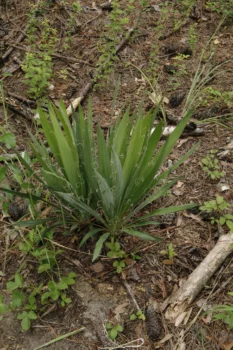
Adam’s Needle: The Spectacular Native Yucca That Thrives on Neglect
If you’re looking for a plant that delivers maximum drama with minimal fuss, meet Adam’s needle (Yucca filamentosa). This striking native perennial proves that sometimes the best garden additions are the ones that practically take care of themselves. With sword-like leaves that look like they belong in a modern art installation and towering flower spikes that can reach 8 feet tall, this southeastern native brings architectural beauty to any landscape.
What Makes Adam’s Needle Special
Adam’s needle gets its common name from the sharp, needle-like points at the tips of its leaves and the curly white threads (filaments) that peel off along the leaf edges – giving it an almost whimsical, slightly wild appearance. The plant forms attractive rosettes of blue-green, sword-shaped leaves that provide year-round structure in the garden.
But the real showstopper happens in summer when mature plants send up dramatic flower stalks laden with clusters of creamy white, bell-shaped blooms. These fragrant flowers are not just beautiful – they’re part of one of nature’s most fascinating partnerships with specialized yucca moths.
A True American Native
Yucca filamentosa is native to the lower 48 states, with its natural range spanning an impressive 29 states from the Southeast to parts of the Midwest and Northeast. You’ll find wild populations thriving from Alabama and Arkansas to Connecticut and Massachusetts, and from Florida to Wisconsin.
- Species observed
- No observations
This wide distribution tells us something important: Adam’s needle is incredibly adaptable and can handle diverse growing conditions across much of the country.
Perfect for Low-Maintenance Landscapes
Here’s where Adam’s needle really shines – it’s practically bulletproof once established. This perennial herb (despite looking like it should be woody, it’s technically classified as a forb) thrives in USDA zones 5-10, making it suitable for most American gardens.
The plant excels in:
- Xeriscape and drought-tolerant gardens
- Rock gardens and contemporary landscapes
- Native plant gardens
- Areas with poor, sandy, or rocky soil
- Slopes and areas prone to erosion
Growing Conditions That Make It Happy
Adam’s needle has simple needs: full sun and well-draining soil. That’s pretty much it! This tough native actually prefers lean, poor soils over rich, amended garden beds. Excellent drainage is crucial – soggy conditions are about the only thing that will reliably kill this plant.
Once established (usually after the first year), it becomes remarkably drought tolerant and can survive on natural rainfall in most climates. The plant grows slowly but steadily, eventually forming clumps 3-4 feet wide and about 2-3 feet tall (not counting the flower stalks).
Planting and Care Tips
Getting Adam’s needle established is straightforward:
- Timing: Plant in spring or fall when temperatures are moderate
- Location: Choose a spot with full sun and excellent drainage
- Soil prep: If you have clay soil, plant on a slope or add gravel to improve drainage
- Watering: Water regularly the first year, then reduce to occasional deep watering during extended dry spells
- Maintenance: Remove spent flower stalks after blooming, divide offsets every few years if desired
Wildlife and Pollinator Benefits
While research shows that Adam’s needle provides only a small percentage (2-5%) of the diet for terrestrial birds and offers sparse cover, its flowers are incredibly valuable to specialized pollinators. The plant has co-evolved with yucca moths in a fascinating mutualistic relationship – the moths pollinate the flowers while laying their eggs in the developing seed pods.
The dramatic flower spikes also attract various bees, beetles, and other nighttime pollinators, making it a unique addition to pollinator gardens.
Design Ideas and Landscape Uses
Adam’s needle works beautifully as:
- A dramatic focal point in contemporary or minimalist landscapes
- Groupings in native plant gardens
- Accent plants among ornamental grasses
- Specimens in rock gardens or xeriscapes
- Architectural elements near modern buildings
The plant’s strong geometric form provides excellent contrast to softer, rounded plants and adds vertical interest to flat landscapes.
Is Adam’s Needle Right for Your Garden?
Adam’s needle is perfect for gardeners who want maximum impact with minimal effort. If you love the idea of a striking, architectural plant that celebrates American native flora while requiring almost no maintenance, this could be your new favorite perennial.
Just remember to give it the drainage it craves and the space it needs to show off those spectacular flower spikes. Your garden – and local pollinators – will thank you for choosing this resilient native beauty.