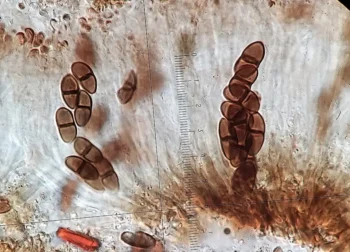
Amandinea punctata: The Tiny Lichen Making a Big Impact in Your Garden
Have you ever noticed small, dark, crusty patches scattered across the bark of trees in your yard? Meet Amandinea punctata, a fascinating lichen that’s probably been quietly living in your garden all along! This unassuming organism might look like just another speck on tree bark, but it’s actually a remarkable partnership between fungi and algae that’s been thriving for millions of years.
What Exactly Is Amandinea punctata?
Amandinea punctata is a crustose lichen native to North America. Unlike plants that we typically think of for gardening, lichens are composite organisms made up of a fungus living in a mutually beneficial relationship with algae or cyanobacteria. The fungus provides structure and protection, while the algae produces food through photosynthesis. It’s nature’s perfect roommate situation!
This particular lichen is also known by several scientific synonyms, including Buellia punctata and Buellia myriocarpa, which you might encounter in older field guides or scientific literature.
Where You’ll Find This Little Wonder
Amandinea punctata has a widespread distribution across North America, making its home from coast to coast. You’ll typically spot it growing on the bark of both deciduous and coniferous trees, as well as on rock surfaces. It’s particularly fond of rough bark and seems to thrive in areas with good air circulation.
How to Identify Amandinea punctata
Spotting this lichen is easier than you might think once you know what to look for:
- Appears as small, dark gray to blackish crusty patches
- Forms circular or irregular shapes that seem glued to the bark surface
- Has a somewhat granular or bumpy texture
- Typically measures just a few millimeters to a couple of centimeters across
- Often has tiny black dots (fruiting bodies called apothecia) scattered across its surface
Is It Beneficial for Your Garden?
Absolutely! While you can’t plant or cultivate Amandinea punctata (lichens establish themselves naturally), having it in your garden is actually a wonderful sign. Here’s why you should be happy to see it:
- Air quality indicator: Lichens are sensitive to air pollution, so their presence indicates good air quality in your garden
- Habitat provider: Tiny insects and other microscopic creatures use lichens as shelter and food sources
- Natural beauty: These living art pieces add subtle texture and interest to tree bark
- Ecosystem health: They contribute to biodiversity and indicate a healthy, balanced environment
Creating Lichen-Friendly Conditions
While you can’t plant Amandinea punctata, you can certainly encourage its natural establishment:
- Maintain clean air around your property by avoiding excessive chemical sprays
- Preserve mature trees with textured bark where lichens love to grow
- Avoid power-washing or scrubbing tree bark unnecessarily
- Keep your garden chemical-free when possible, as lichens are sensitive to pollutants
- Be patient – lichens grow very slowly and may take years to become noticeable
Common Misconceptions
Let’s clear up a few myths about lichens like Amandinea punctata:
- They don’t harm trees: Lichens are epiphytes, meaning they simply use trees as a surface to grow on without causing damage
- They’re not parasites: Unlike mistletoe or other parasitic plants, lichens don’t steal nutrients from their host trees
- They’re not a sign of disease: Healthy trees can and often do support thriving lichen communities
The Bottom Line
Amandinea punctata might not be the showiest addition to your garden, but it’s certainly one of the most fascinating. This tiny lichen serves as a living indicator of your garden’s environmental health while contributing to the complex web of life that makes ecosystems thrive. Next time you’re walking through your yard, take a moment to appreciate these remarkable little organisms quietly doing their part to make your garden a more diverse and healthy place.
Remember, the best thing you can do for lichens like Amandinea punctata is simply to let them be. They’ll find their own way to your trees and rocks, and once established, they’ll be faithful garden companions for years to come!