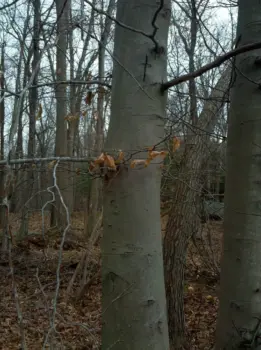
American Beech: A Majestic Native Tree for Large Landscapes
If you’ve ever wandered through an eastern North American forest and marveled at a tree with smooth, elephant-gray bark and golden fall foliage, you’ve likely encountered the magnificent American beech (Fagus grandifolia). This native beauty has been gracing our landscapes for centuries, and it might just be the perfect addition to your property – if you have the space for it!
Meet the American Beech
The American beech is a true native gem, naturally occurring across a vast range from southeastern Canada down to northern Florida and stretching west to Wisconsin, southeastern Minnesota, eastern Kansas, and eastern Texas. You’ll find this stately tree growing in states including Alabama, Arkansas, Connecticut, Delaware, Florida, Georgia, Illinois, Indiana, Kentucky, Louisiana, Maine, Maryland, Massachusetts, Michigan, Minnesota, Mississippi, Missouri, New Hampshire, New Jersey, New York, North Carolina, Ohio, Oklahoma, Pennsylvania, Rhode Island, South Carolina, Tennessee, Texas, Utah, Vermont, Virginia, West Virginia, and Wisconsin, plus several Canadian provinces.
- Species observed
- No observations
As a perennial tree with a single trunk, American beech can live for centuries and eventually reach impressive heights of up to 80 feet tall. Don’t expect instant gratification though – this tree has a slow growth rate, typically reaching about 30 feet in its first 20 years.
Why You’ll Fall in Love with American Beech
There’s something almost magical about American beech trees. Here’s what makes them special:
- Stunning bark: That smooth, silvery-gray bark is a year-round showstopper
- Fall color: Leaves turn a warm golden-bronze that lights up autumn landscapes
- Winter interest: Young trees hold onto their bronze leaves through winter, creating texture in the dormant season
- Wildlife magnet: The nuts (beechnuts) feed small mammals like squirrels and chipmunks, making up 10-25% of their diet
- Pollinator support: Small spring flowers provide early nectar for bees and other pollinators
Where American Beech Shines
American beech works beautifully as a specimen tree in large yards, naturalized woodland areas, or parks. It’s particularly stunning in mature landscape designs where its eventual size can be properly appreciated. This tree prefers upland areas and typically grows in non-wetland conditions, though it can occasionally tolerate some moisture.
Thanks to its excellent shade tolerance, American beech can thrive as an understory tree or in partially shaded areas, making it valuable for layered woodland plantings.
Growing American Beech Successfully
Ready to add this native beauty to your landscape? Here’s what you need to know:
Hardiness: American beech is remarkably hardy, thriving in USDA zones 3-9 and tolerating temperatures as low as -44°F.
Soil preferences:
- Coarse to medium-textured soils work best
- pH range of 4.1 to 7.2 (slightly acidic to neutral)
- Good drainage is essential
- Low fertility requirements make it easy to please
Light and water needs:
- Shade tolerant but grows best with some sun
- Medium moisture requirements
- High drought tolerance once established
- Needs 28-80 inches of annual precipitation
Planting and Care Tips
American beech trees are routinely available from nurseries and can be propagated by seed or grown in containers. Here’s how to give yours the best start:
- Timing: Plant in spring after frost danger passes
- Spacing: Give it plenty of room – plan for 300-800 trees per acre in naturalized settings
- Seeds: If starting from seed, cold stratification is required (about 1,600 seeds per pound)
- Establishment: Seedlings have low vigor initially, so be patient
- Root depth: Ensure at least 32 inches of root depth space
Is American Beech Right for You?
American beech is an excellent choice if you:
- Have a large property with space for a 80-foot tree
- Want to support native wildlife
- Appreciate trees with year-round interest
- Don’t mind waiting for slow but steady growth
- Have well-draining soil
However, you might want to consider alternatives if you:
- Have a small yard or limited space
- Need quick results (remember that slow growth rate!)
- Have heavy clay or poorly draining soil
- Live in an area with high fire risk (it has medium fire tolerance)
A Tree for Generations
With its long lifespan and slow, steady growth, American beech is truly a tree you plant for future generations. While you might not see it reach its full majesty in your lifetime, you’ll be creating a legacy that will provide beauty, wildlife habitat, and environmental benefits for decades to come. Plus, there’s something deeply satisfying about growing a tree that’s been part of North American forests since long before European settlement.
Whether you’re creating a naturalized woodland garden or adding a statement tree to a large landscape, American beech offers the perfect combination of native heritage, wildlife value, and timeless beauty. Just make sure you have the space – this gentle giant needs room to truly shine!