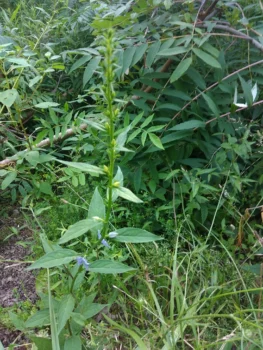
American Bellflower: A Towering Native Beauty for Your Garden
If you’re looking for a native plant that makes a big statement without being a diva, meet the American bellflower (Campanulastrum americanum). This tall, graceful annual might just become your new favorite garden companion – especially if you love plants that do their thing with minimal fuss while providing maximum wow factor.
What Makes American Bellflower Special?
American bellflower is a true native gem, naturally found across a huge swath of North America. This hardy annual calls home to states stretching from the Great Lakes region down to the Gulf Coast, including Alabama, Arkansas, Florida, Georgia, Illinois, Indiana, Iowa, Kansas, Kentucky, Louisiana, Maryland, Michigan, Minnesota, Mississippi, Missouri, Nebraska, New Jersey, New York, North Carolina, Ohio, Oklahoma, Pennsylvania, South Carolina, South Dakota, Tennessee, Virginia, West Virginia, and Wisconsin. It’s also native to parts of Ontario, Canada.
- Species observed
- No observations
As an annual forb (that’s garden-speak for a non-woody plant that completes its life cycle in one growing season), American bellflower has a fascinating growth habit that sets it apart from many garden plants.
The Look: Tall, Blue, and Beautiful
American bellflower is definitely not a shrinking violet – this beauty can reach up to 6 feet tall! With its rapid growth rate and single-crown growth form, it creates impressive vertical spikes topped with gorgeous blue bell-shaped flowers. The medium-textured green foliage provides a lovely backdrop for those show-stopping blooms that appear throughout the summer months.
The flowers are truly the star of the show – bright blue bells that are conspicuous from a distance and absolutely magnetic to pollinators. While the brown seeds that follow aren’t particularly showy, they’re an important food source for wildlife.
Where Does It Fit in Your Garden?
American bellflower is incredibly versatile in the landscape. Its towering height makes it perfect for:
- Back of perennial borders where it won’t overshadow shorter plants
- Woodland edges and naturalized areas
- Native plant gardens and prairie restorations
- Rain gardens and areas with variable moisture
- Cottage gardens where a bit of wild charm is welcome
Since it’s shade tolerant, American bellflower thrives in spots where many other flowering annuals would struggle. This makes it particularly valuable for adding color to partially shaded areas of your garden.
Growing Conditions: Surprisingly Adaptable
One of the best things about American bellflower is how easygoing it is about soil conditions. It adapts well to coarse, medium, and fine-textured soils, with a pH tolerance ranging from 5.5 to 7.5. Here’s what it prefers:
- Moisture: Medium water needs, though it has low drought tolerance
- Soil: Well-draining but moisture-retentive soils work best
- Light: Shade tolerant, making it great for woodland settings
- Temperature: Needs at least 160 frost-free days and minimum temperatures above 52°F
The wetland status varies by region – it’s quite flexible, able to grow in both wetland and upland conditions depending on your location.
Planting and Care Tips
Growing American bellflower is refreshingly straightforward:
- Seeding: Direct sow seeds in fall or early spring. With about 700,000 seeds per pound, a little goes a long way!
- Spacing: Plant 4,800 to 11,000 plants per acre, or roughly 4-6 inches apart in smaller plantings
- No fuss required: Once established, this plant pretty much takes care of itself
- Support: In windy areas, you might want to stake taller specimens
- Self-seeding: It will readily self-sow for next year’s display
The seeds have medium seedling vigor and spread slowly, so you won’t need to worry about it taking over your garden unexpectedly.
Wildlife and Pollinator Benefits
American bellflower is a pollinator magnet! Those bright blue summer blooms attract bees, butterflies, and other beneficial insects looking for nectar. As a native plant, it has co-evolved with local wildlife and provides resources that non-native plants simply can’t match.
The plant is active through spring, summer, and fall, providing a long season of benefits to garden visitors.
Why Choose American Bellflower?
If you’re building a native garden, supporting pollinators, or just want a reliable tall annual that brings vertical interest and beautiful blue color to your landscape, American bellflower checks all the boxes. It’s particularly valuable for gardeners dealing with partial shade, where many other flowering options are limited.
Plus, as an annual, it gives you the flexibility to change up your garden design each year while still supporting native ecosystems. And with its ability to self-seed, you might just find pleasant surprises popping up in new spots next season!
So if you’re ready to add some native charm and towering blue beauty to your garden, give American bellflower a try. Your local pollinators – and your garden – will thank you for it.