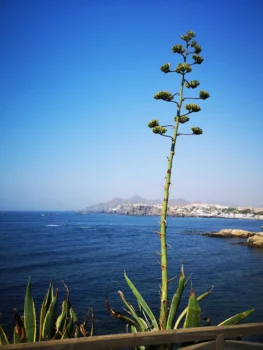
American Century Plant: A Dramatic Desert Beauty for Your Garden
Looking for a plant that makes a bold statement while requiring minimal water? The American century plant (Agave americana) might be exactly what your landscape needs. This striking succulent creates an instant focal point with its massive rosette of blue-green leaves, each armed with impressive spines that demand respect.
What is the American Century Plant?
The American century plant is a large perennial succulent that grows as a single crown rosette. Despite its common name suggesting it lives for a century, this long-lived plant typically survives 10-30 years before producing its spectacular once-in-a-lifetime flower show. The plant gets its dramatic appearance from thick, fleshy leaves that can reach up to 6 feet in length, each ending in a sharp terminal spine with smaller spines running along the edges.
Where Does It Grow Naturally?
This impressive agave is native to Mexico and parts of the southwestern United States, including Arizona, California, and Texas. However, it has naturalized and now grows wild in Florida, Hawaii, Louisiana, and the U.S. Virgin Islands. You’ll find it thriving in areas that receive 8-14 inches of annual precipitation and can handle temperatures down to about 12°F.
- Species observed
- No observations
Why Consider Growing American Century Plant?
There are several compelling reasons to add this architectural beauty to your landscape:
- Drought tolerance: Once established, it requires very little water, making it perfect for water-wise gardening
- Low maintenance: This slow-growing plant needs minimal care and has low fertility requirements
- Year-round interest: The dense, coarse-textured foliage provides structure and color throughout all seasons
- Fire resistant: A valuable trait for gardens in fire-prone areas
- Wildlife value: When it finally blooms, the tall flower spike attracts pollinators including bats, birds, and insects
Perfect Garden Settings
The American century plant shines in:
- Desert and xeriscape gardens
- Modern and contemporary landscapes
- Mediterranean-style gardens
- Rock gardens and succulent displays
- Areas where you want a dramatic focal point
Growing Conditions and Care
Success with American century plant comes down to mimicking its native desert environment:
Sunlight: Full sun is essential – this plant is shade intolerant and needs bright light to maintain its compact form and blue-green color.
Soil: Well-draining soil is absolutely critical. It adapts well to coarse and medium-textured soils but struggles in fine, clay soils that retain moisture. A pH between 6.0-8.0 works well.
Water: Low water needs once established. In fact, overwatering is more likely to kill this plant than drought.
Climate: Hardy in USDA zones 8-11, requiring at least 300 frost-free days per year. In marginal zones, provide protection during cold snaps.
Space: Give it room to grow – mature plants can reach 6 feet tall and equally wide.
Planting and Maintenance Tips
Plant your American century plant in spring after the last frost. Dig a hole only as deep as the root ball but twice as wide, ensuring the crown sits at ground level. Water sparingly during the first year while roots establish, then reduce watering frequency.
The plant requires virtually no pruning, though you may want to remove spent flower stalks after blooming (which signals the end of the plant’s life). Watch for offset plants or pups that develop around the base – these can be carefully removed and replanted to start new colonies.
Important Considerations
Before planting, consider these factors:
- Sharp spines: Place away from walkways and play areas due to dangerous leaf spines
- Size: Needs ample space and isn’t suitable for small gardens
- Slow growth: Patience is required as it takes years to reach mature size
- Regional considerations: While native to southwestern states, it has naturalized elsewhere. Consider native alternatives if you’re outside its natural range
Native Alternatives to Consider
If you’re gardening outside the plant’s native range or prefer strictly regional natives, consider these alternatives that offer similar dramatic appeal:
- Native agave species specific to your region
- Native yuccas for similar architectural form
- Regional desert or dry-adapted native plants
The Bottom Line
The American century plant offers unmatched drought tolerance and architectural beauty for the right garden setting. While it requires patience due to slow growth and careful placement due to its spines, it rewards gardeners with decades of striking presence and eventual spectacular blooms. Just make sure you have the space, appropriate climate, and appreciation for bold, dramatic plants before adding this desert giant to your landscape.