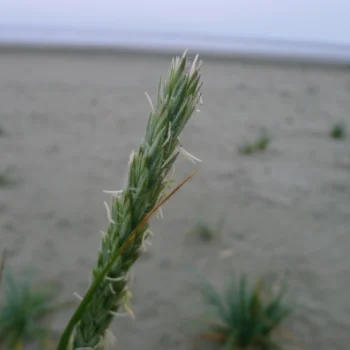
American Dunegrass: The Coastal Champion Your Garden Needs
If you’re looking for a tough, no-nonsense grass that can handle whatever Mother Nature throws at it, meet American dunegrass (Leymus mollis mollis). This hardy perennial grass is like the reliable friend who shows up in a storm – dependable, resilient, and surprisingly useful to have around.
What Makes American Dunegrass Special?
American dunegrass is a true North American native with an impressive resume. This rhizomatous grass calls home to an enormous range spanning from Alaska down to California, across Canada’s provinces, and even reaching into the Great Lakes region and northeastern United States. You’ll find it thriving in Alberta, British Columbia, Alaska, Manitoba, New Brunswick, California, Nova Scotia, Ontario, Prince Edward Island, Quebec, Saskatchewan, Northwest Territories, Nunavut, Illinois, Maine, Massachusetts, Michigan, New Hampshire, Oregon, Pennsylvania, Washington, Wisconsin, Labrador, and Newfoundland.
- Species observed
- No observations
Also known by several scientific synonyms including Elymus mollis and Elymus arenarius subspecies mollis, this grass has been helping stabilize coastlines and challenging landscapes for centuries.
Why Your Garden Will Love American Dunegrass
American dunegrass isn’t your typical lawn grass – it’s so much better for specific challenging situations. Here’s why gardeners are increasingly turning to this coastal champion:
- Erosion control superstar: Those spreading rhizomes create an underground network that holds soil together beautifully
- Salt-tolerant: Perfect for coastal properties where salt spray kills other plants
- Drought champion: Once established, it laughs at dry spells
- Low maintenance: Set it and (mostly) forget it
- Fast establishment: Rapid growth rate means quick results
The Nitty-Gritty: Size and Appearance
American dunegrass grows into substantial clumps reaching up to 4 feet tall with a coarse texture and dense summer foliage that becomes more open in winter. The foliage is an attractive green, and while it produces small yellow flowers in late spring, they’re not particularly showy – this grass earns its keep through function rather than flashy blooms. The growth form is distinctly rhizomatous, spreading underground to form colonies.
Perfect Garden Situations
This isn’t the grass for a manicured suburban lawn, but it’s absolutely perfect for:
- Coastal landscapes and dune restoration
- Erosion control on slopes and banks
- Naturalized prairie or meadow areas
- Xeriscaping and water-wise gardens
- Challenging sites where other grasses fail
- Wildlife habitat gardens (provides cover and nesting material)
Growing Conditions: Give It What It Wants
American dunegrass is surprisingly particular about some things while being incredibly tolerant of others:
- Soil: Loves coarse, sandy soils but struggles in fine-textured clay
- pH: Adaptable to slightly acidic to alkaline conditions (pH 6.0-8.0)
- Moisture: Moderate water needs, but excellent drought tolerance once established
- Salt tolerance: Exceptional – perfect for coastal conditions
- Sun exposure: Full sun only – this grass doesn’t do shade
- Temperature: Extremely cold hardy, tolerating temperatures down to 7°F
Planting and Care Tips
Getting American dunegrass established is straightforward if you follow these guidelines:
Planting: This grass is typically propagated by sprigs rather than seed, as seed production is minimal. Plant sprigs in spring or fall when temperatures are moderate. Space plantings 3,000 to 11,000 plants per acre depending on your coverage goals and timeline.
Establishment: While seedling vigor is considered low, once this grass takes hold, its rapid growth rate means you’ll see results relatively quickly. The underground rhizome system spreads at a moderate rate, gradually filling in gaps.
Maintenance: This is where American dunegrass really shines – it needs very little once established. No fertilizer requirements (it actually prefers low fertility), minimal watering after the first season, and no pest problems to speak of.
Seasonal care: Active growth occurs in spring and fall. The grass doesn’t retain leaves through winter but regrows vigorously each spring. After harvest or cutting, regrowth is slow, so avoid frequent mowing.
A Few Considerations
While American dunegrass is fantastic for the right situation, it’s not perfect for every garden:
- It can’t handle foot traffic well, so it’s not suitable for play areas
- The coarse texture won’t appeal to those wanting a refined lawn
- It needs full sun and won’t tolerate any shade
- Clay soils are a no-go – this grass needs good drainage
The Bottom Line
American dunegrass is a specialist that excels in challenging conditions where other grasses give up. If you have a coastal property, erosion issues, sandy soil, or just want a truly low-maintenance native grass for naturalized areas, this could be your perfect match. It’s commercially available and ready to prove that sometimes the toughest plants make the most reliable garden companions.
Give American dunegrass the right conditions – sandy soil, full sun, and room to spread – and it will reward you with years of dependable performance and the satisfaction of growing a true North American native that’s perfectly adapted to its environment.