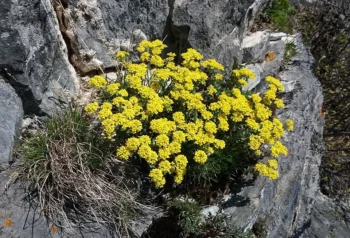
American Madwort: A Rare Arctic Native Worth Knowing
Meet American madwort (Alyssum obovatum), one of North America’s most elusive native wildflowers. While you’ve probably never encountered this little perennial in your local garden center, this fascinating plant has quietly made its home in some of the continent’s most remote northern reaches for centuries.
What is American Madwort?
American madwort is a native perennial forb – essentially a non-woody flowering plant that comes back year after year. As a member of the mustard family, it shares botanical kinship with more familiar garden plants, though it’s adapted to much harsher conditions than most of its relatives.
You might occasionally see this plant listed under its synonym Alyssum americanum in older botanical references, but Alyssum obovatum is the currently accepted scientific name.
Where Does American Madwort Grow?
This is where things get interesting – and challenging for most gardeners. American madwort is native to Alaska, Yukon, and the Northwest Territories, making it one of our most northerly native wildflowers. Its natural range is extremely limited, confined to the Arctic and subarctic regions of North America.
- Species observed
- No observations
Should You Grow American Madwort?
Here’s where I need to be completely honest with you: growing American madwort in your garden is likely not practical for most North American gardeners. This plant has evolved specifically for Arctic conditions that are nearly impossible to replicate in temperate gardens.
However, if you’re gardening in Alaska or the far northern territories where this plant naturally occurs, it could be a wonderful addition to a native plant garden – assuming you can find ethically sourced plants or seeds.
Growing Conditions (What We Know)
While specific cultivation information for American madwort is scarce, we can make some educated assumptions based on its native habitat:
- Extremely cold hardy (likely USDA zones 1-3)
- Adapted to short growing seasons
- Probably requires excellent drainage
- Likely thrives in full sun to partial shade
- May need winter chilling requirements
The Reality Check
If you’re captivated by the idea of American madwort but live outside its native range, consider these excellent alternatives that offer similar charm but are much more garden-friendly:
- Sweet alyssum (though not native, widely adaptable)
- Native rock cresses (Boechera species)
- Wild columbine for mountain gardens
- Local native mustard family plants
Conservation Consideration
Given American madwort’s extremely limited range, any cultivation efforts should focus on conservation and education rather than widespread gardening use. If you’re in its native range and interested in growing it, work with local native plant societies and ensure any plant material is responsibly sourced.
The Bottom Line
American madwort represents one of those fascinating plants that reminds us of nature’s incredible diversity and specialization. While it may not be destined for your backyard border, learning about plants like this helps us appreciate the complex web of native species that make up North America’s botanical heritage.
For most gardeners, American madwort is better appreciated from afar – a reminder that some plants are perfectly content in their wild homes, adapted to conditions we can admire but shouldn’t try to replicate in our gardens.