Native Plants

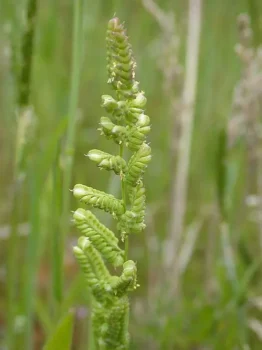
American Sloughgrass

Beckmannia syzigachne

USDA symbol: BESY

annual grass

Alaska: native
Canada: native
Greenland: native
Lower 48 states: native

If you’ve ever wondered what to plant in that perpetually soggy corner of your yard, let me introduce you to American sloughgrass (Beckmannia syzigachne). This unassuming annual grass might not win any beauty contests, but it’s absolutely perfect for those tricky wet spots where other plants fear to tread. American ...

American Sloughgrass: A Hidden Gem for Wetland Gardens

If you’ve ever wondered what to plant in that perpetually soggy corner of your yard, let me introduce you to American sloughgrass (Beckmannia syzigachne). This unassuming annual grass might not win any beauty contests, but it’s absolutely perfect for those tricky wet spots where other plants fear to tread.

What Exactly Is American Sloughgrass?

American sloughgrass is a native annual grass that’s basically the ultimate wetland specialist. While most plants throw in the towel when their roots get waterlogged, this hardy grass practically does a happy dance in soggy soil. It’s classified as an Obligate Wetland plant across all regions of North America, which means it almost always occurs in wetlands – think of it as nature’s way of saying this plant lives for wet feet!

Where Does It Call Home?

This grass has quite the impressive passport! American sloughgrass is native across a huge swath of North America, including Alaska, Canada, Greenland, and much of the lower 48 states. You’ll find it naturally growing from the Atlantic to the Pacific, spanning states like:

  • Northern states: Alaska, Montana, North Dakota, Minnesota, Wisconsin, Michigan
  • Western states: California, Oregon, Washington, Idaho, Utah, Colorado
  • Plains states: Kansas, Nebraska, Wyoming, South Dakota
  • Eastern regions: Maine, New York, Pennsylvania, Ohio
  • And many more across the continent
  • Species observed
  • No observations

Why You Might Want This Wetland Wonder

Okay, so American sloughgrass won’t stop traffic with its stunning blooms (it’s wind-pollinated, so the flowers are pretty modest). But here’s where it shines: this grass is absolutely invaluable for wetland restoration, erosion control, and naturalizing wet areas. If you’re dealing with:

  • Soggy areas where nothing else will grow
  • Rain garden projects
  • Pond or stream edges that need stabilizing
  • Bioswales or other water management features
  • Wetland restoration projects

Then American sloughgrass could be your new best friend! It grows as an annual, typically reaching 1-4 feet tall with a delicate, graceful appearance that adds subtle texture to wet meadow settings.

Growing Conditions and Hardiness

This grass is remarkably adaptable across USDA hardiness zones 2-7, making it suitable for most northern and temperate regions. Here’s what it needs to thrive:

  • Moisture: Consistently moist to wet soils – the wetter, the better!
  • Light: Full sun to partial shade
  • Soil: Tolerates various soil types as long as they stay moist
  • Flooding: Actually tolerates and even benefits from seasonal flooding

Planting and Care Tips

Growing American sloughgrass is refreshingly straightforward – after all, this plant is built to handle challenging conditions! Here’s how to get started:

Starting from Seed: Plant seeds in spring directly in your wet area. Since it’s an annual, you’ll need to replant each year or allow it to self-seed naturally.

Site Preparation: Make sure your planting area stays consistently moist. If you’re creating a rain garden or bioswale, ensure proper water flow to the area.

Maintenance: Here’s the best part – once established, American sloughgrass requires minimal care! Just ensure it doesn’t dry out completely, and nature will handle the rest.

The Bottom Line

American sloughgrass might not be the flashiest plant in your garden, but it serves a crucial ecological role. It’s perfect for gardeners who want to work with nature rather than against it, especially in those challenging wet areas. Plus, you’ll be supporting native plant communities and providing habitat structure for wetland wildlife.

If you’re dealing with wet, difficult spots in your landscape, don’t fight the moisture – embrace it with American sloughgrass! Your soggy yard problems might just become your greatest gardening success story.

Beckmannia syzigachne is also known as...

Often we refer to plants by their common names. When shopping for plants the scientific name is the best way to positively identify the plant species you desire. But some plants have more than one name! While it doesn't happen often, nurseries might display one name while you're searching for another. Beckmannia syzigachne is also known as:

Beckmannia eruciformis auct. non | USDA symbol: BEER2
Beckmannia eruciformis Host ssp. baicalensis Hultén | USDA symbol: BEERB
Beckmannia eruciformis Host var. uniflora ex | USDA symbol: BEERU
Beckmannia syzigachne Fernald ssp. baicalensis Koyama & | USDA symbol: BESYB
Beckmannia syzigachne Fernald var. uniflora | USDA symbol: BESYU

Why do some plants have more than one name? Over time plant species may be renamed for a few reasons:

  1. Botanists in different regions named the same plant without knowing it had already been classified.
  2. A species was reclassified after scientific advances in, for example, DNA analysis.
  3. Slight variations within a species are sometimes mistakenly identified as entirely new species.

Wetland Status

The rule of seasoned gardeners and landscapers is to choose the "right plant for the right place" — matching plants to their ideal growing conditions, so they'll thrive with less care and fewer inputs. But the simplicity of this catchphrase conceals how tricky plant selection can be if you don't have the right information. While tags on nursery plants list watering requirements, there's more to the story.

Knowing a plant's wetland status can simplify the process by revealing the interaction between plants, water, and soil. You might be surprised to learn that popular landscape plants are wetland species! And what may be a wetland plant in one area, in another it might thrive in drier conditions. The table below gives insight into the preferred growing conditions of this plant throughout its geographical distribution.

Region
Preferred Habitat

Alaska ()

Obligate Wetland

Arid West (AZ, CA, CO, ID, MT, NV, NM, OR, TX, UT, WA, WY)

Obligate Wetland

Atlantic and Gulf Coastal Plain (AL, AR, DC, DE, FL, GA, IL, KY, LA, MD, MS, MO, NC, NJ, OK, PA, SC, TN, TX, VA)

Obligate Wetland

Eastern Mountains and Piedmont (AL, AR, DC, DE, GA, IL, IN, KS, KY, MD, MO, NC, NJ, NY, OH, OK, PA, SC, TN, VA, WV)

Obligate Wetland

Great Plains (CO, KS, MN, MT, NE, NM, ND, OK, SD, TX, WY)

Obligate Wetland

Midwest (IL, IN, IA, KS, KY, MI, MN, MO, NE, ND, OK, OH, SD, WI)

Obligate Wetland

Northcentral & Northeast ()

Obligate Wetland

Western Mountains, Valleys, and Coast (AZ, CA, CO, ID, MT, NV, NM, OR, SD, UT, WA, WY)

Obligate Wetland
Wetland Glossary
Obligate Wetland
Facultative Wetland
Facultative
Facultative Upland
Obligate Upland
Almost always occurs in wetlands
Usually occurs in wetlands but may occur in non-wetlands
Can occur in wetlands and non-wetlands
Usually occurs in non-wetlands but may occur in wetlands
Almost never occurs in wetlands

Classification

Group: Monocot
Kingdom: Plantae - Plants
Subkingdom: Tracheobionta - Vascular plants
Superdivision: Spermatophyta - Seed plants
Division: Magnoliophyta - Flowering plants
Class: Liliopsida - Monocotyledons
Subclass: Commelinidae
Order: Cyperales
Family: Poaceae Barnhart - Grass family
Genus: Beckmannia Host - sloughgrass

Species: Beckmannia syzigachne (Steud.) Fernald - American sloughgrass

Plant data source: USDA, NRCS 2025. The PLANTS Database. https://plants.usda.gov,. 2/25/2025. National Plant Data Team, Greensboro, NC USA