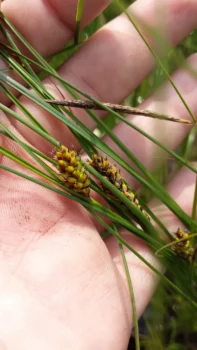
American Woollyfruit Sedge: A Hardy Native for Wet Gardens
If you’re looking for a tough, low-maintenance native plant that thrives in those soggy spots where other plants struggle, let me introduce you to American woollyfruit sedge (Carex lasiocarpa var. americana). This unassuming but incredibly useful sedge might just become your new best friend for challenging wet areas in your landscape.
What is American Woollyfruit Sedge?
American woollyfruit sedge is a perennial grass-like plant that belongs to the sedge family. Don’t let the grass-like description fool you into thinking it’s ordinary – sedges are actually quite different from true grasses and often much more interesting! This particular variety is also known by its synonyms Carex lanuginosa var. americana and Carex lasiocarpa ssp. americana in botanical circles.
Where Does It Come From?
This sedge is a true North American native with an impressively wide distribution. You’ll find it naturally occurring from Alaska down through Canada and across much of the United States. Its range spans from the Pacific Coast states like California, Oregon, and Washington, through the Rocky Mountain states including Colorado, Idaho, Montana, and Utah, across the Great Plains and Midwest, and into the Northeast and Mid-Atlantic regions.
The plant grows in an extensive list of states and provinces: Alberta, British Columbia, Alaska, Manitoba, New Brunswick, California, Nova Scotia, Ontario, Colorado, Connecticut, Quebec, Saskatchewan, Yukon, Northwest Territories, Idaho, Illinois, Indiana, Iowa, Maine, Maryland, Massachusetts, Michigan, Minnesota, Montana, Nebraska, New Hampshire, New Jersey, New York, North Carolina, North Dakota, Ohio, Oregon, Pennsylvania, Rhode Island, Utah, Vermont, Virginia, Washington, Wisconsin, Wyoming, and even Labrador and Newfoundland.
- Species observed
- No observations
A Word About Rarity
Here’s something important to keep in mind: while American woollyfruit sedge has a wide overall range, it’s actually considered rare in some areas. In New Jersey, for example, it has a rarity status of S2, meaning it’s imperiled in the state. If you’re planning to add this plant to your garden, please make sure you source it responsibly from reputable native plant nurseries rather than collecting from wild populations.
Why Grow American Woollyfruit Sedge?
This sedge is perfect for gardeners who want to:
- Fill wet, boggy areas where other plants struggle
- Create naturalistic plantings that support local ecosystems
- Establish low-maintenance groundcover
- Add fine texture and movement to the landscape
- Support native wildlife with indigenous plants
Where to Use It in Your Landscape
American woollyfruit sedge shines in wet garden situations. Consider it for:
- Rain gardens and bioswales
- Pond and stream margins
- Wetland restoration projects
- Low-lying areas that stay consistently moist
- Naturalistic meadow plantings in wet soils
Growing Conditions and Care
This sedge is wonderfully adaptable and hardy, typically thriving in USDA hardiness zones 2-7. It prefers:
- Wet to consistently moist soils
- Full sun to partial shade conditions
- Natural or amended soils that retain moisture well
Once established, American woollyfruit sedge is remarkably low-maintenance. It forms colonies over time, creating dense groundcover that helps prevent erosion in wet areas. The plant’s fine-textured foliage adds subtle beauty to the landscape and provides habitat for various wildlife species.
Planting and Care Tips
Getting started with American woollyfruit sedge is straightforward:
- Plant in spring or early fall when temperatures are moderate
- Choose locations that stay consistently moist or wet
- Space plants according to nursery recommendations for eventual spread
- Water regularly during the first growing season to establish roots
- Minimal fertilization needed – this plant thrives in natural conditions
- Cut back old foliage in late winter or early spring if desired
The Bottom Line
American woollyfruit sedge might not be the showiest plant in your garden, but it’s definitely one of the hardest working. If you have wet areas that need reliable, native groundcover, this sedge delivers both function and ecological value. Just remember to source it responsibly, especially if you’re in an area where it’s considered rare. Your local native plant society or extension office can help you find reputable suppliers.
Sometimes the most valuable plants are the ones that quietly do their job while supporting the broader ecosystem – and American woollyfruit sedge fits that description perfectly.