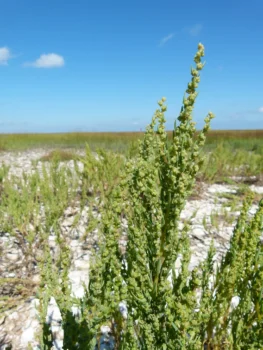
Annual Seepweed: A Specialized Native for Salt-Tolerant Gardens
If you’re dealing with challenging coastal conditions or creating a specialized salt marsh garden, annual seepweed (Suaeda linearis) might just be the unsung hero you didn’t know you needed. This humble native plant won’t win any beauty contests, but it’s a champion when it comes to thriving in conditions that would make most garden plants throw in the towel.
What Exactly Is Annual Seepweed?
Annual seepweed is a native forb that’s perfectly adapted to life in salty, wet environments. As its name suggests, this is an annual plant, meaning it completes its entire life cycle in one growing season. Don’t let its modest appearance fool you – this little plant is doing some serious environmental heavy lifting in coastal ecosystems across the eastern United States.
You might also see this plant referred to by its scientific name, Suaeda linearis, or its former botanical name, Dondia linearis. But we’ll stick with annual seepweed since it’s much easier to remember!
Where Does Annual Seepweed Call Home?
This salt-loving native has quite an impressive range across the eastern United States. You’ll find annual seepweed naturally growing in states from Maine down to Florida and as far west as Texas. It’s particularly common along the Atlantic and Gulf coasts, where it thrives in salt marshes, brackish wetlands, and other challenging coastal environments.
- Species observed
- No observations
Should You Plant Annual Seepweed in Your Garden?
Here’s where we need to be honest – annual seepweed isn’t your typical garden plant. This specialized native is designed for very specific growing conditions that most home gardens simply can’t provide. However, there are some situations where it might be exactly what you’re looking for:
- You’re working on a coastal restoration project
- You have naturally occurring salt marsh or brackish wetland areas on your property
- You’re creating a specialized educational or demonstration salt marsh garden
- You’re dealing with salt spray or salt-contaminated soil near coastal areas
What Does Annual Seepweed Look Like?
Let’s set expectations appropriately – annual seepweed isn’t going to be the showstopper in your landscape design. This low-growing herb typically reaches just 6-24 inches tall, with narrow, linear leaves that have a succulent quality to help them cope with salt stress. The tiny, greenish flowers are wind-pollinated and quite inconspicuous, appearing in small clusters along the stems during summer and early fall.
While it may not be conventionally beautiful, there’s something appealing about its tough, no-nonsense appearance and its ability to thrive where other plants fail.
Growing Conditions: Not for the Faint of Heart
Annual seepweed has very specific requirements that make it challenging to grow in typical garden settings:
- Soil: Requires saline or brackish wetland conditions – regular garden soil won’t cut it
- Moisture: Needs constantly wet to saturated conditions
- Salt tolerance: Actually requires some salt in the growing environment to thrive
- Sunlight: Prefers full sun exposure
- Hardiness zones: Suitable for USDA zones 6-10
The Reality Check: Why Most Gardeners Should Skip This One
Unless you’re working with naturally occurring wetland conditions or involved in habitat restoration, annual seepweed probably isn’t the right choice for your garden. It’s classified as an obligate wetland plant across all regions where it grows, meaning it almost always occurs in wetlands and requires those specific conditions to survive.
Trying to grow annual seepweed in a typical garden setting would be like trying to keep a fish in a bird cage – it’s just not going to work out well for anyone involved.
Wildlife and Ecological Benefits
While annual seepweed may not be a pollinator magnet (its flowers are wind-pollinated rather than insect-pollinated), it plays an important role in coastal ecosystems. These plants help stabilize salt marsh soils and provide habitat structure in environments where few other plants can survive. They’re part of the complex web of specialized plants that make coastal wetlands function properly.
The Bottom Line
Annual seepweed is a fascinating example of plant adaptation, but it’s definitely a specialist rather than a generalist. If you’re working on coastal restoration, managing natural wetland areas, or dealing with salt-contaminated soils near the coast, this tough little native might be exactly what you need. For everyone else, there are plenty of other native plants that will be much happier (and more successful) in typical garden conditions.
Remember, the best native plant for your garden is one that naturally wants to grow in the conditions you can provide. Sometimes the most ecological thing we can do is appreciate these specialized plants in their natural habitats rather than trying to force them into our gardens.