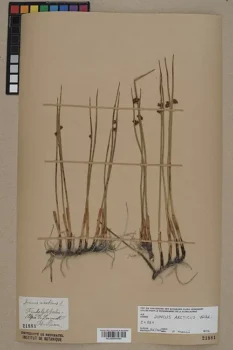
Arctic Rush: A Hardy Native for Wet Gardens
If you’re looking for a tough, low-maintenance plant that thrives in those soggy spots where other plants fear to tread, let me introduce you to arctic rush (Juncus arcticus). This unassuming perennial might not win any beauty contests, but it’s absolutely brilliant at what it does – turning wet, difficult areas into functional, naturalized landscapes.
What Is Arctic Rush?
Arctic rush is a perennial graminoid – basically a grass-like plant that’s actually a member of the rush family (Juncaceae). Don’t let the name fool you; while it’s certainly cold-hardy, this adaptable native grows far beyond the Arctic Circle. It forms dense clumps of slender, blue-green to gray-green stems that sway gracefully in the breeze, creating a soft, textural element in wet garden areas.
Where Arctic Rush Calls Home
This remarkable plant has one of the most impressive native ranges you’ll find. Juncus arcticus is native to Alaska, Canada, Greenland, and St. Pierre and Miquelon, making it a true northern native. However, its range extends much further south than you might expect, growing naturally across an enormous swath of North America including Alberta, British Columbia, Manitoba, New Brunswick, Nova Scotia, Ontario, Prince Edward Island, Quebec, Saskatchewan, Yukon, Northwest Territories, and Nunavut. In the lower 48 states, you’ll find it thriving in Arizona, Arkansas, California, Colorado, Idaho, Illinois, Indiana, Iowa, Kansas, Maine, Maryland, Massachusetts, Michigan, Minnesota, Missouri, Montana, Nebraska, Nevada, New Hampshire, New Mexico, New York, North Dakota, Ohio, Oklahoma, Oregon, Pennsylvania, Rhode Island, South Dakota, Texas, Utah, Vermont, Virginia, Washington, West Virginia, Wisconsin, and Wyoming, plus Labrador and Newfoundland.
- Species observed
- No observations
Why Choose Arctic Rush for Your Garden?
Arctic rush is classified as an obligate wetland plant in Alaska, meaning it almost always occurs in wetlands. This makes it absolutely perfect for those challenging wet spots in your landscape where other plants struggle to survive. Here’s why you might want to consider adding it to your garden:
- Problem solver: Thrives in consistently wet soils where many plants would rot
- Low maintenance: Once established, it pretty much takes care of itself
- Wildlife friendly: Seeds provide food for birds, and dense clumps offer nesting habitat
- Erosion control: Excellent for stabilizing wet soil areas
- Natural look: Perfect for creating naturalized, prairie-like landscapes
Perfect Garden Situations
Arctic rush isn’t the plant for formal flower borders or drought-tolerant xeriscapes. Instead, it shines in:
- Rain gardens and bioswales
- Pond and stream margins
- Bog gardens
- Wetland restoration projects
- Naturalized prairie gardens
- Areas with poor drainage
Growing Conditions and Care
The beauty of arctic rush lies in its simplicity. This plant is incredibly hardy, thriving in USDA zones 2-7, which means it can handle some seriously cold winters. Here’s what it needs to flourish:
- Light: Full sun to partial shade (though it performs best with plenty of sunlight)
- Soil: Consistently moist to wet soils; highly adaptable to different soil types
- pH: Tolerates a wide range of soil pH levels
- Water: Constant moisture is key – this isn’t a plant for dry conditions
Planting and Maintenance Tips
Getting arctic rush established is refreshingly straightforward:
- Plant in spring or fall when temperatures are moderate
- Space plants 12-18 inches apart for good coverage
- Keep soil consistently moist during establishment
- Once established, minimal care is needed
- Can spread by rhizomes, so give it room to naturalize
- Divide clumps every few years if you want to control spread or propagate new plants
The Bottom Line
Arctic rush won’t give you showy flowers or dramatic foliage, but what it lacks in flashiness, it makes up for in reliability and ecological value. If you have a wet area that needs covering, want to support local wildlife, or are working on a restoration project, this native beauty is definitely worth considering. It’s one of those plants that quietly does its job while asking for very little in return – and honestly, don’t we all need more plants like that in our gardens?