Native Plants

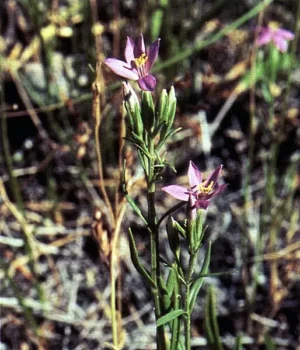
Arizona Centaury

Centaurium calycosum

USDA symbol: CECA3

annual forb

Lower 48 states: native

If you’re looking for a delicate native wildflower that thrives in those tricky wet areas of your garden, Arizona centaury (Centaurium calycosum) might just be your new best friend. This unassuming little annual or biennial packs a surprising punch with its cheerful pink blooms and remarkable adaptability to moisture-loving conditions. ...

Arizona Centaury: A Charming Native Wildflower for Wet Spots

If you’re looking for a delicate native wildflower that thrives in those tricky wet areas of your garden, Arizona centaury (Centaurium calycosum) might just be your new best friend. This unassuming little annual or biennial packs a surprising punch with its cheerful pink blooms and remarkable adaptability to moisture-loving conditions.

Meet the Arizona Centaury

Arizona centaury is a native forb – essentially a non-woody flowering plant – that calls the south-central United States home. Despite its common name suggesting southwestern origins, this plant is actually found across Missouri, Oklahoma, and Texas. It’s also known by several scientific synonyms, including Centaurium breviflorum and Zeltnera calycosa, which you might encounter in older gardening references.

  • Species observed
  • No observations

As an annual or biennial, Arizona centaury completes its life cycle in one to two years, making it a dynamic addition to naturalized plantings where it can self-seed and maintain its presence year after year.

Why Grow Arizona Centaury?

There are several compelling reasons to consider adding this native beauty to your landscape:

  • Wetland warrior: With its facultative wetland status across multiple regions, it’s perfect for rain gardens, pond edges, and other moisture-rich areas where many plants struggle
  • Pollinator magnet: The small pink to rose-purple flowers attract native bees, butterflies, and other beneficial insects
  • Low maintenance: Once established, it requires minimal care and will often self-seed for future generations
  • Native heritage: Supporting local ecosystems by choosing plants that naturally belong in your region

Garden Design and Landscape Role

Arizona centaury shines in naturalized settings where its delicate beauty can be appreciated without competing with showier garden plants. Consider using it in:

  • Wildflower meadows and prairie restorations
  • Rain gardens and bioswales
  • Native plant gardens
  • Wetland edge plantings
  • Areas with clay or moisture-retentive soils

Its modest stature and gentle appearance make it an excellent companion for other native wetland plants like cardinal flower, blue flag iris, or swamp milkweed.

Growing Conditions and Care

Arizona centaury is surprisingly adaptable, thriving in USDA hardiness zones 6 through 9. Here’s what it needs to flourish:

Light: Full sun to partial shade – it’s quite flexible with lighting conditions

Soil: Moist to wet soils are preferred, and it tolerates clay soils better than many plants. While it’s classified as facultative wetland, it can handle occasional dry periods

Water: Consistent moisture is key, especially during germination and early growth

Planting and Establishment Tips

Getting Arizona centaury established is relatively straightforward:

  • Seeding: Direct seed in fall or early spring when temperatures are cool and moisture is abundant
  • Site preparation: Minimal soil preparation is needed – this plant appreciates naturalized conditions
  • Spacing: Allow plants to self-seed naturally for the most authentic appearance
  • Maintenance: Once established, little care is needed beyond ensuring adequate moisture during dry spells

The Bottom Line

Arizona centaury may not be the flashiest plant in your garden, but it offers something equally valuable – reliable beauty in challenging wet conditions and support for native wildlife. For gardeners dealing with persistently moist areas or those passionate about native plant gardening, this charming wildflower deserves serious consideration. Its ability to self-seed and return year after year makes it a gift that keeps on giving, both to your garden and to the local ecosystem it naturally supports.

Centaurium calycosum is also known as...

Often we refer to plants by their common names. When shopping for plants the scientific name is the best way to positively identify the plant species you desire. But some plants have more than one name! While it doesn't happen often, nurseries might display one name while you're searching for another. Centaurium calycosum is also known as:

Centaurium breviflorum | USDA symbol: CEBR8
Centaurium calycosum Fernald var. breviflorum | USDA symbol: CECAB
Centaurium calycosum Fernald var. nanum | USDA symbol: CECAN
Erythraea calycosa | USDA symbol: ERCA41
Zeltnera calycosa | USDA symbol: ZECA3

Why do some plants have more than one name? Over time plant species may be renamed for a few reasons:

  1. Botanists in different regions named the same plant without knowing it had already been classified.
  2. A species was reclassified after scientific advances in, for example, DNA analysis.
  3. Slight variations within a species are sometimes mistakenly identified as entirely new species.

Wetland Status

The rule of seasoned gardeners and landscapers is to choose the "right plant for the right place" — matching plants to their ideal growing conditions, so they'll thrive with less care and fewer inputs. But the simplicity of this catchphrase conceals how tricky plant selection can be if you don't have the right information. While tags on nursery plants list watering requirements, there's more to the story.

Knowing a plant's wetland status can simplify the process by revealing the interaction between plants, water, and soil. You might be surprised to learn that popular landscape plants are wetland species! And what may be a wetland plant in one area, in another it might thrive in drier conditions. The table below gives insight into the preferred growing conditions of this plant throughout its geographical distribution.

Region
Preferred Habitat

Arid West (AZ, CA, CO, ID, MT, NV, NM, OR, TX, UT, WA, WY)

Facultative Wetland

Atlantic and Gulf Coastal Plain (AL, AR, DC, DE, FL, GA, IL, KY, LA, MD, MS, MO, NC, NJ, OK, PA, SC, TN, TX, VA)

Facultative Wetland

Great Plains (CO, KS, MN, MT, NE, NM, ND, OK, SD, TX, WY)

Facultative Wetland

Midwest (IL, IN, IA, KS, KY, MI, MN, MO, NE, ND, OK, OH, SD, WI)

Facultative Wetland

Western Mountains, Valleys, and Coast (AZ, CA, CO, ID, MT, NV, NM, OR, SD, UT, WA, WY)

Facultative Wetland
Wetland Glossary
Obligate Wetland
Facultative Wetland
Facultative
Facultative Upland
Obligate Upland
Almost always occurs in wetlands
Usually occurs in wetlands but may occur in non-wetlands
Can occur in wetlands and non-wetlands
Usually occurs in non-wetlands but may occur in wetlands
Almost never occurs in wetlands

Classification

Group: Dicot
Kingdom: Plantae - Plants
Subkingdom: Tracheobionta - Vascular plants
Superdivision: Spermatophyta - Seed plants
Division: Magnoliophyta - Flowering plants
Class: Magnoliopsida - Dicotyledons
Subclass: Asteridae
Order: Gentianales
Family: Gentianaceae Juss. - Gentian family
Genus: Centaurium Hill - centaury

Species: Centaurium calycosum (Buckley) Fernald - Arizona centaury

Plant data source: USDA, NRCS 2025. The PLANTS Database. https://plants.usda.gov,. 2/25/2025. National Plant Data Team, Greensboro, NC USA