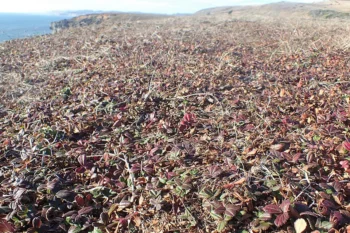
Beach Strawberry: A Coastal Groundcover with Sweet Rewards
If you’ve ever wandered along Pacific coastlines and spotted carpets of glossy green leaves dotted with white flowers and bright red berries, you’ve likely encountered the delightful beach strawberry (Fragaria chiloensis). This charming perennial groundcover brings both beauty and function to coastal gardens, offering everything from erosion control to edible treats.
What Is Beach Strawberry?
Beach strawberry is a low-growing perennial forb that spreads via runners (stolons) to form dense mats. Rather than growing tall and woody like shrubs, this herbaceous plant stays close to the ground, typically reaching only about 8 inches in height. Its prostrate, spreading growth form makes it an excellent groundcover choice for areas where you want living carpet rather than vertical interest.
Where Does Beach Strawberry Grow?
This coastal native has a complex relationship with different regions. It’s naturally found growing in British Columbia, Alaska, California, Hawaii, New York, Oregon, and Washington. However, its native status varies by location – it’s considered native to Canada and Hawaii, but introduced in Alaska where it now reproduces on its own. Its status in the lower 48 states is less clearly defined.
- Species observed
- No observations
Why Gardeners Love Beach Strawberry
There are several compelling reasons to consider beach strawberry for your landscape:
- Beautiful blooms: Conspicuous white flowers appear in early spring, creating lovely contrast against the green foliage
- Edible fruit: The bright red berries are not only ornamental but also edible, though smaller than commercial strawberries
- Excellent groundcover: Its stoloniferous growth habit means it spreads rapidly to fill in bare areas
- Pollinator support: Early spring flowers provide nectar for bees and other pollinators when few other plants are blooming
- Low maintenance: Once established, it requires minimal care and has moderate drought tolerance
Garden Design Uses
Beach strawberry shines in several landscape applications:
- Coastal gardens where it can handle salt spray and sandy soils
- Erosion control on slopes and banks
- Naturalized areas and wildlife gardens
- Edible landscaping as an ornamental food plant
- Rock gardens and areas with well-draining soil
- Groundcover under taller shrubs and trees
Growing Conditions
Beach strawberry is fairly adaptable but performs best when its preferences are met:
- Soil: Well-draining, coarse to medium-textured soils (avoid heavy clay)
- pH: Slightly acidic to neutral (5.8-7.8)
- Moisture: Moderate water needs; established plants handle some drought
- Light: Intermediate shade tolerance, but flowers best with morning sun
- Hardiness: Cold hardy to -33°F (USDA zones 4-9)
- Fertility: Low fertilizer requirements
Interestingly, beach strawberry has a Facultative Upland wetland status across all regions, meaning it usually grows in non-wetland areas but can tolerate some moisture.
Planting and Care Tips
Getting beach strawberry established is relatively straightforward:
- Timing: Plant in spring after frost danger passes
- Spacing: Space plants 1-2 feet apart (2,700-11,000 plants per acre for large areas)
- Planting depth: Set at the same depth as in the container, ensuring roots can reach at least 10 inches deep
- First year care: Water regularly while establishing; growth rate is moderate
- Long-term maintenance: Divide clumps every 3-4 years to maintain vigor
- Propagation: Easily grown from seed or by dividing runners/sprigs
A Note on Native Status
Before planting beach strawberry, consider its native status in your specific region. While it’s a wonderful plant, it’s not native everywhere it’s currently found. If you’re in an area where it’s not indigenous, you might want to explore native groundcover alternatives that provide similar benefits while supporting local ecosystems. Your local native plant society can help identify the best native options for your area.
Is Beach Strawberry Right for Your Garden?
Beach strawberry could be perfect for your landscape if you’re looking for a low-maintenance groundcover that offers spring flowers, summer fruit, and year-round foliage. It’s particularly well-suited to coastal conditions and naturalized settings. However, like any spreading groundcover, it can become aggressive in ideal conditions, so plan accordingly and be prepared to manage its spread if needed.
With its combination of ornamental value, edible fruit, and ecological benefits for pollinators, beach strawberry offers a lot of bang for your gardening buck – just make sure it’s appropriate for your specific location and garden goals.