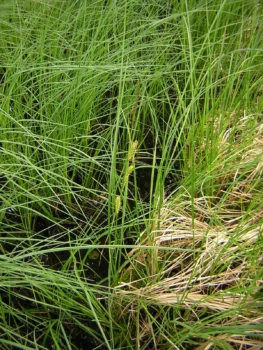
Beaked Sedge: The Perfect Native Plant for Your Wetland Garden
If you’ve been searching for a reliable, low-maintenance native plant that thrives in those tricky wet spots in your yard, let me introduce you to beaked sedge (Carex rostrata). This unassuming but incredibly useful perennial sedge might just become your new best friend in the garden – especially if you’re dealing with soggy soil that makes other plants throw in the towel.
Meet the Beaked Sedge
Beaked sedge is a grass-like perennial that belongs to the sedge family. Don’t let its modest appearance fool you – this hardy native has been quietly doing its job across North America for centuries. Growing up to 3.5 feet tall with an upright, rhizomatous growth form, it spreads at a moderate pace to create natural-looking colonies that are perfect for naturalized plantings.
Where Beaked Sedge Calls Home
This remarkable sedge has one of the most impressive native ranges you’ll find. Carex rostrata is native throughout Alaska, Canada (including Alberta, British Columbia, Manitoba, New Brunswick, Nova Scotia, Ontario, Prince Edward Island, Quebec, Saskatchewan, Yukon, Northwest Territories, and Nunavut), Greenland, and numerous states across the northern United States including Idaho, Illinois, Michigan, Minnesota, Montana, New Jersey, New York, Washington, and Wisconsin.
- Species observed
- No observations
Why Your Garden Needs Beaked Sedge
Here’s where beaked sedge really shines: it’s what botanists call an obligate wetland plant, meaning it almost always occurs in wetlands. This makes it absolutely perfect for those challenging wet areas where other plants struggle to survive. Whether you have a rain garden, pond margin, or just a perpetually soggy spot in your yard, beaked sedge will not only tolerate these conditions – it will thrive in them.
The plant produces brown flowers in late spring that, while not particularly showy, add subtle texture to the landscape. Its green foliage maintains a medium texture throughout the growing season, and the porous foliage structure provides nice movement in the breeze.
Perfect Garden Situations
Beaked sedge is ideally suited for:
- Wetland restoration projects
- Rain gardens and bioswales
- Pond and stream margins
- Bog gardens
- Naturalized wetland areas
- Areas with poor drainage
Growing Conditions and Care
One of the best things about beaked sedge is how accommodating it is once you understand its needs. This plant is incredibly cold-hardy (surviving temperatures as low as -38°F) and adaptable to various soil types, though it prefers fine to medium-textured soils over coarse ones.
Soil and Moisture: Beaked sedge requires consistently moist to wet conditions and has high moisture requirements. It can tolerate anaerobic (waterlogged) conditions better than most plants, making it perfect for areas that stay saturated.
Light Requirements: This adaptable sedge is shade tolerant, so it works well in areas that receive partial shade to full sun.
pH and Soil Chemistry: It prefers slightly acidic to neutral soils (pH 4.5-7.0) and has medium tolerance for calcium carbonate but low tolerance for salinity.
Planting and Establishment
Beaked sedge is routinely available commercially and can be propagated by seed, bare root, or sprigs. Here are some key tips for success:
- Plant in spring when soil temperatures warm up
- Space plants 2,700-4,800 per acre for restoration projects
- Ensure consistent moisture during establishment
- Be patient – seedling vigor is low, so establishment can be slow initially
- Once established, the moderate vegetative spread rate will help fill in areas naturally
The good news is that beaked sedge requires minimal maintenance once established. It has a moderate growth rate and lifespan, so you won’t need to worry about aggressive spreading or frequent replacement.
Wildlife and Ecological Benefits
As a native sedge, beaked sedge provides important habitat structure in wetland ecosystems. The dense, rhizomatous growth helps prevent soil erosion in wet areas, making it valuable for both aesthetic and functional landscape purposes.
Is Beaked Sedge Right for Your Garden?
Beaked sedge is an excellent choice if you have wet or seasonally flooded areas that need vegetation. It’s particularly valuable for gardeners interested in creating authentic native plant communities or dealing with drainage challenges. However, if your garden has well-drained soils or you’re looking for showy flowering plants, you might want to consider other options.
This reliable native sedge may not win any beauty contests, but it’s exactly the kind of hardworking, low-maintenance plant that makes challenging garden spots manageable while supporting local ecosystems. Sometimes the most valuable plants are the ones that quietly do their job without any fuss – and beaked sedge definitely fits that description perfectly.