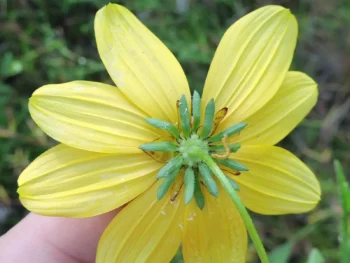
Bearded Beggarticks: A Late-Season Wildflower That’s Worth the Sticky Seeds
If you’ve ever taken a walk through a meadow in late summer and found your socks covered in tiny barbed seeds, you’ve likely met bearded beggarticks (Bidens aristosa). While those clingy seeds might seem like a nuisance, this cheerful native wildflower deserves a spot in your garden—especially if you’re looking to support pollinators when other flowers are calling it quits for the season.
What is Bearded Beggarticks?
Bearded beggarticks is an annual wildflower native to most of the United States, spreading across 35 states from Maine down to Texas and west to Colorado. This hardy plant belongs to the sunflower family and produces bright yellow, daisy-like flowers that bloom from late summer into fall. True to its name, the plant develops distinctive barbed seeds (the beggarticks) that easily attach to clothing, fur, and anything else that brushes against them.
The plant typically reaches about 3.5 feet tall with an erect, single-crowned growth form. Its coarse-textured green foliage provides a nice backdrop for the conspicuous yellow flowers, and it grows rapidly once established.
- Species observed
- No observations
Why Grow Bearded Beggarticks?
Despite its somewhat weedy reputation, bearded beggarticks offers several compelling reasons to include it in your landscape:
- Late-season pollinator magnet: When most flowers are fading, bearded beggarticks provides crucial nectar and pollen for bees, butterflies, and other pollinators preparing for winter
- Wildlife food source: The seeds provide 5-10% of the diet for various large animals, making it valuable for wildlife habitat
- Easy to grow: This fast-growing annual thrives with minimal care and readily self-sows
- Native plant benefits: As a native species, it supports local ecosystems and requires fewer resources than non-native alternatives
Where Does It Fit in Your Garden?
Bearded beggarticks works best in informal, naturalized settings rather than formal flower borders. Consider it for:
- Prairie or meadow restorations
- Wetland gardens and rain gardens
- Wildlife habitat areas
- Casual wildflower plantings
- Back-of-border locations where height is desired
Since it has a facultative wetland status across all regions, it’s particularly well-suited for areas that stay consistently moist but can also tolerate some drier conditions.
Growing Conditions and Care
One of bearded beggarticks’ best qualities is its adaptability. Here’s what it prefers:
- Soil: Adapts to fine and medium-textured soils; pH between 5.0-7.0
- Moisture: High moisture use—thrives in consistently moist to wet conditions
- Light: Intermediate shade tolerance, but performs best in full to partial sun
- Temperature: Needs at least 140 frost-free days and minimum temperatures above 52°F
- Hardiness: Suitable for USDA zones 3-9 based on its native range
Planting and Propagation
Growing bearded beggarticks is refreshingly simple:
- From seed: Direct sow seeds in spring—no cold stratification required
- Seeding rate: With approximately 130,000 seeds per pound, a little goes a long way
- Germination: Seeds have high vigor and germinate readily
- Self-seeding: Plants self-sow rapidly and seeds persist well, ensuring future generations
The plant is routinely available commercially, making it easy to source seeds for your garden.
Managing the Spread
Here’s where those sticky seeds become important to consider. Bearded beggarticks spreads rapidly by seed, and those barbed seeds are incredibly efficient at finding new homes. If you’re concerned about it spreading beyond where you want it:
- Cut flower heads before seeds fully mature
- Plant it in areas where natural spread is welcome
- Consider it for larger, less formal spaces rather than small, manicured gardens
The Bottom Line
Bearded beggarticks might not win any beauty contests, but it’s a hardworking native that provides valuable late-season resources for pollinators and wildlife. If you have space for a naturalized area and appreciate low-maintenance plants that support local ecosystems, this cheerful yellow wildflower could be just what your garden needs. Just be prepared to share those sticky seeds with anyone who walks through your garden in fall—consider it nature’s way of spreading the love!