Native Plants

Blue Mudplantain

Heteranthera limosa

USDA symbol: HELI2

annual forb

Lower 48 states: native
Puerto Rico: native

If you’re looking to add a splash of delicate blue color to your water garden or soggy backyard spot, let me introduce you to blue mudplantain (Heteranthera limosa). This charming little native might not have the flashiest name, but don’t let that fool you – it’s a hardworking beauty that ...

Blue Mudplantain: A Hidden Gem for Water-Loving Gardens

If you’re looking to add a splash of delicate blue color to your water garden or soggy backyard spot, let me introduce you to blue mudplantain (Heteranthera limosa). This charming little native might not have the flashiest name, but don’t let that fool you – it’s a hardworking beauty that deserves a place in more American gardens.

What Exactly Is Blue Mudplantain?

Blue mudplantain is an annual forb – basically a soft-stemmed plant without woody tissue – that’s perfectly at home in wet places. As a native species found across much of the United States and Puerto Rico, this little plant has been quietly doing its thing in our wetlands for centuries. You might also see it listed under its former scientific name, Pontederia limosa, in older gardening references.

Where Does It Call Home?

This adaptable native has quite the range! You can find blue mudplantain growing naturally across a impressive swath of states: Arizona, Arkansas, California, Colorado, Florida, Illinois, Iowa, Kansas, Kentucky, Louisiana, Minnesota, Mississippi, Missouri, Nebraska, New Mexico, Oklahoma, South Dakota, Tennessee, Texas, and Puerto Rico. That’s quite a tour of America’s diverse landscapes!

  • Species observed
  • No observations

Why Your Garden (and Local Wildlife) Will Love It

Here’s where blue mudplantain really shines – it’s what botanists call an obligate wetland plant across all regions where it grows. This means it almost always occurs in wetlands, making it absolutely perfect if you have a wet spot in your yard that other plants struggle with.

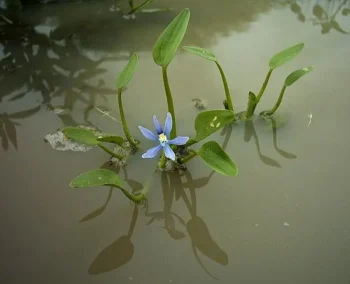
The small blue to violet flowers might be modest in size, but they’re pollinator magnets for native bees and flies. Plus, those heart-shaped leaves create a lovely carpet effect along pond edges or in rain gardens. And since it’s an annual, it’ll readily self-seed in the right conditions, giving you a renewable display year after year.

Perfect Garden Spots for Blue Mudplantain

This plant is tailor-made for:

  • Water gardens and pond margins
  • Rain gardens and bioswales
  • Bog gardens
  • Native plant restoration areas
  • Wildlife habitat gardens
  • Any consistently moist to wet garden area

Growing Blue Mudplantain Successfully

The good news? Blue mudplantain is refreshingly low-maintenance once you understand its simple needs.

Light Requirements: It thrives in full sun to partial shade, so you have some flexibility with placement.

Soil and Water: The key to success is keeping the soil consistently moist to wet. This plant can handle seasonal flooding like a champ – in fact, it prefers it! If you have that soggy spot where other plants struggle, this could be your solution.

Hardiness: Being native across such a wide range, blue mudplantain adapts to USDA zones 3-10, depending on your specific region.

Planting Tips: Spring planting works best. Since it’s an annual, focus on creating the right conditions for self-seeding. Once established in suitable habitat, it should return naturally each year.

The Bottom Line

Blue mudplantain might not be the showiest plant in the garden center, but it’s exactly the kind of reliable native that makes ecological gardening work. If you have wet areas to manage, want to support local pollinators, or are working on a native plant garden, this humble beauty deserves serious consideration. Sometimes the best garden solutions are the ones that have been quietly thriving in our landscapes all along.

Heteranthera limosa is also known as...

Often we refer to plants by their common names. When shopping for plants the scientific name is the best way to positively identify the plant species you desire. But some plants have more than one name! While it doesn't happen often, nurseries might display one name while you're searching for another. Heteranthera limosa is also known as:

Pontederia limosa | USDA symbol: POLI7

Why do some plants have more than one name? Over time plant species may be renamed for a few reasons:

  1. Botanists in different regions named the same plant without knowing it had already been classified.
  2. A species was reclassified after scientific advances in, for example, DNA analysis.
  3. Slight variations within a species are sometimes mistakenly identified as entirely new species.

Wetland Status

The rule of seasoned gardeners and landscapers is to choose the "right plant for the right place" — matching plants to their ideal growing conditions, so they'll thrive with less care and fewer inputs. But the simplicity of this catchphrase conceals how tricky plant selection can be if you don't have the right information. While tags on nursery plants list watering requirements, there's more to the story.

Knowing a plant's wetland status can simplify the process by revealing the interaction between plants, water, and soil. You might be surprised to learn that popular landscape plants are wetland species! And what may be a wetland plant in one area, in another it might thrive in drier conditions. The table below gives insight into the preferred growing conditions of this plant throughout its geographical distribution.

Region
Preferred Habitat

Arid West (AZ, CA, CO, ID, MT, NV, NM, OR, TX, UT, WA, WY)

Obligate Wetland

Atlantic and Gulf Coastal Plain (AL, AR, DC, DE, FL, GA, IL, KY, LA, MD, MS, MO, NC, NJ, OK, PA, SC, TN, TX, VA)

Obligate Wetland

Caribbean (PR, VI)

Obligate Wetland

Eastern Mountains and Piedmont (AL, AR, DC, DE, GA, IL, IN, KS, KY, MD, MO, NC, NJ, NY, OH, OK, PA, SC, TN, VA, WV)

Obligate Wetland

Great Plains (CO, KS, MN, MT, NE, NM, ND, OK, SD, TX, WY)

Obligate Wetland

Midwest (IL, IN, IA, KS, KY, MI, MN, MO, NE, ND, OK, OH, SD, WI)

Obligate Wetland

Northcentral & Northeast ()

Obligate Wetland

Western Mountains, Valleys, and Coast (AZ, CA, CO, ID, MT, NV, NM, OR, SD, UT, WA, WY)

Obligate Wetland
Wetland Glossary
Obligate Wetland
Facultative Wetland
Facultative
Facultative Upland
Obligate Upland
Almost always occurs in wetlands
Usually occurs in wetlands but may occur in non-wetlands
Can occur in wetlands and non-wetlands
Usually occurs in non-wetlands but may occur in wetlands
Almost never occurs in wetlands

Classification

Group: Monocot
Kingdom: Plantae - Plants
Subkingdom: Tracheobionta - Vascular plants
Superdivision: Spermatophyta - Seed plants
Division: Magnoliophyta - Flowering plants
Class: Liliopsida - Monocotyledons
Subclass: Liliidae
Order: Liliales
Family: Pontederiaceae Kunth - Water-Hyacinth family
Genus: Heteranthera Ruiz & Pav. - mudplantain

Species: Heteranthera limosa (Sw.) Willd. - blue mudplantain

Plant data source: USDA, NRCS 2025. The PLANTS Database. https://plants.usda.gov,. 2/25/2025. National Plant Data Team, Greensboro, NC USA