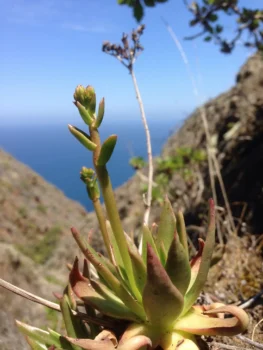
Bright Green Dudleya: A Rare Coastal Gem Worth Growing Responsibly
Meet the bright green dudleya (Dudleya virens virens), a stunning succulent that’s as special as it is beautiful. This California native isn’t your typical garden center find – it’s a rare coastal treasure that deserves a spot in the right garden, grown with the right intentions.
What Makes Bright Green Dudleya Special
This perennial succulent forms gorgeous rosettes of thick, fleshy leaves that live up to its name with their vibrant green color. As a member of the stonecrop family, it shares DNA with popular garden succulents but brings something uniquely Californian to the table. In spring and early summer, tall flower spikes emerge from the center of each rosette, crowned with clusters of small white to pale yellow flowers that practically glow against the coastal backdrop.
Where It Calls Home
The bright green dudleya is a true California endemic, meaning it exists nowhere else on Earth naturally. You’ll find wild populations along the state’s coastal areas, with some of the most notable communities on the Channel Islands and nearby mainland coastal bluffs.
- Species observed
- No observations
A Word of Caution: Rarity Matters
Here’s where things get serious – this beautiful plant has a Global Conservation Status of S2?T1, which indicates it’s quite rare in the wild. Before you get excited about adding one to your garden, it’s crucial to source plants responsibly. This means:
- Only purchase from reputable nurseries that propagate from legally obtained stock
- Never collect plants from the wild (it’s often illegal and always harmful to wild populations)
- Consider growing this plant as part of conservation efforts rather than just decoration
Why Grow Bright Green Dudleya?
If you can source it responsibly, here’s why this succulent deserves garden space:
- Drought tolerance: Once established, it thrives on minimal water – perfect for water-wise gardens
- Low maintenance: This isn’t a fussy plant that needs constant attention
- Pollinator magnet: Those delicate flowers attract bees and other beneficial insects
- Unique beauty: You won’t find anything quite like it at the big box store
- Conservation value: You’re helping preserve a rare species by growing it responsibly
Perfect Garden Homes
Bright green dudleya shines in:
- Mediterranean-style gardens
- Rock gardens and succulent collections
- Coastal landscapes
- Native plant gardens
- Container gardens (with excellent drainage)
Growing Conditions That Make It Happy
Think coastal California, and you’ll understand what this plant craves:
- Sunlight: Full sun to partial shade (morning sun with afternoon protection in hot inland areas)
- Soil: Well-draining is non-negotiable – rocky, sandy, or amended clay works well
- Water: Minimal once established; overwatering is the kiss of death
- Climate: Hardy in USDA zones 9-11, prefers coastal conditions
- Air circulation: Good airflow prevents fungal issues
Planting and Care Tips
Best planting time: Fall gives plants time to establish before summer heat
Planting process:
- Choose a spot with excellent drainage – consider raised beds or slopes
- Amend heavy clay soils with coarse sand, perlite, or gravel
- Plant at the same depth it was growing in the container
- Water lightly after planting, then back off
Ongoing care:
- Water deeply but infrequently during the first year
- Once established, rely mainly on natural rainfall
- Remove spent flower stalks to keep plants tidy
- Protect from hard frost in marginal areas
- Watch for aphids on flower stalks – rinse off with water
The Bottom Line
Bright green dudleya isn’t for every gardener or every garden, but for those who appreciate rare native plants and can provide the right conditions, it’s a true gem. Remember, with great beauty comes great responsibility – only grow this special succulent if you can source it ethically and give it the care it deserves. Your garden will be richer for it, and you’ll be doing your part to keep this coastal treasure alive for future generations.