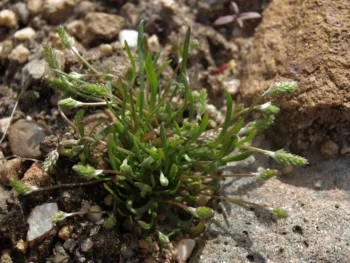
Bristly Mousetail: A Tiny Native with Big Ecological Value
Meet one of North America’s most unassuming native plants: the bristly mousetail (Myosurus apetalus var. montanus). Don’t let its humble appearance fool you – this petite annual forb plays an important role in western ecosystems and deserves consideration for specialized native gardens.
What Is Bristly Mousetail?
Bristly mousetail is a small annual forb native to both Canada and the lower 48 states. As a member of the buttercup family, it’s a delicate plant that lacks woody tissue and completes its entire life cycle in a single growing season. The mousetail name comes from its distinctive elongated flower spikes that somewhat resemble a mouse’s tail.
You might also encounter this plant listed under its synonyms Myosurus aristatus ssp. montanus or Myosurus minimus ssp. montanus in older botanical references.
Where Does Bristly Mousetail Grow?
This hardy little plant has quite an impressive range across western North America. You’ll find bristly mousetail growing naturally in Alberta, Saskatchewan, Arizona, California, Colorado, Montana, Nevada, New Mexico, North Dakota, Oregon, South Dakota, Utah, and Wyoming. It’s particularly well-adapted to montane (mountain) environments, as suggested by its variety name montanus.
- Species observed
- No observations
Should You Grow Bristly Mousetail in Your Garden?
Let’s be honest – bristly mousetail won’t win any beauty contests. This plant is tiny, inconspicuous, and produces flowers so small you might need a magnifying glass to appreciate them. So why would anyone want to grow it?
Reasons to Consider Bristly Mousetail:
- Native plant gardening: Perfect for gardeners committed to using only regional native species
- Restoration projects: Excellent choice for restoring disturbed montane habitats
- Educational value: Great for teaching about native plant diversity and small-scale ecology
- Minimal maintenance: As an annual, it self-seeds and requires virtually no care
- Ecological authenticity: Provides habitat for specialized insects that depend on native flora
Reasons You Might Skip It:
- Limited ornamental value: Extremely small and inconspicuous
- Short-lived display: Annual lifecycle means no permanent garden structure
- Specialized growing conditions: May not thrive outside its preferred habitat
Growing Conditions and Care
While specific growing information for bristly mousetail is limited, we can make educated assumptions based on its natural habitat and related species. This mountain-dwelling annual likely prefers:
- Soil: Moist, well-draining soils, possibly with some clay content
- Light: Full sun to partial shade
- Water: Consistent moisture, especially during spring growth
- Climate: Cool, montane conditions (likely USDA zones 3-7)
Planting and Propagation Tips
Since bristly mousetail is an annual forb, growing it successfully means creating conditions that encourage natural self-seeding:
- Direct seeding: Sow seeds in fall or early spring when soil is consistently moist
- Minimal soil disturbance: Once established, avoid heavy cultivation that might disrupt the seed bank
- Patience required: Seeds may remain dormant for multiple seasons before germinating
- Natural cycles: Allow the plant to complete its full lifecycle for future generations
The Bottom Line
Bristly mousetail is definitely not for every gardener or every garden. It’s best suited for dedicated native plant enthusiasts, restoration specialists, or anyone creating a comprehensive montane ecosystem garden. While it won’t provide showy blooms or dramatic foliage, it offers the satisfaction of preserving a piece of North America’s natural heritage.
If you’re looking for more ornamental native alternatives with similar growing conditions, consider other montane wildflowers like western pasqueflower, mountain candytuft, or alpine forget-me-not – species that offer both native authenticity and visual appeal.
For those committed to growing bristly mousetail, remember that success with this species is measured not in garden drama, but in ecological authenticity and the quiet satisfaction of nurturing one of nature’s more modest creations.