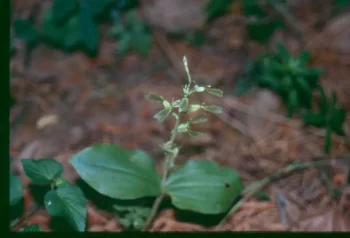
Broadlipped Twayblade: A Delicate Native Orchid for Woodland Gardens
If you’re drawn to the subtle beauty of native orchids and have a shady, moist spot in your garden, the broadlipped twayblade (Listera convallarioides) might just be the perfect addition to your woodland sanctuary. This diminutive perennial orchid brings quiet elegance to naturalized landscapes across northern North America.
What Makes Broadlipped Twayblade Special
Don’t let the name fool you – this isn’t your typical flashy orchid. The broadlipped twayblade is a member of the forb family, meaning it’s a non-woody perennial that dies back to ground level each winter. What makes it truly special is its status as a native species with an impressive range across Alaska, Canada, and much of the northern United States.
This little orchid grows as a rhizomatous plant, slowly spreading underground to form small colonies over time. At maturity, it reaches about 1 foot tall with a moderate growth rate, making it perfect for those patient gardeners who appreciate plants that take their time to establish.
Where You’ll Find It Growing Wild
The broadlipped twayblade has one of the most extensive native ranges you’ll find, naturally occurring across Alberta, British Columbia, Alaska, New Brunswick, Arizona, California, Nova Scotia, Ontario, Colorado, Prince Edward Island, Quebec, Idaho, Maine, Michigan, Minnesota, Montana, Nevada, New Hampshire, New York, Oregon, South Dakota, Utah, Vermont, Washington, Wisconsin, Wyoming, and Newfoundland. That’s quite the travel résumé!
- Species observed
- No observations
Garden Appeal and Landscape Role
While the broadlipped twayblade won’t stop traffic with bold blooms, its charm lies in its understated woodland character. The small white flowers appear in late spring arranged in delicate spikes, creating a subtle display that rewards close observation. The medium-textured green foliage provides gentle ground-level interest throughout the growing season.
This plant shines in:
- Woodland and shade gardens
- Native plant landscapes
- Naturalized bog or wetland areas
- Conservation plantings
- Areas where you want to encourage biodiversity
Understanding Its Water Needs
Here’s where things get interesting – the broadlipped twayblade has different moisture preferences depending on where you live. In some regions, it behaves as a facultative wetland plant (usually found in wet areas), while in others, it can tolerate drier upland conditions. This adaptability makes it versatile for various garden situations, from consistently moist woodland floors to occasionally wet areas.
Growing Conditions That Make It Happy
The broadlipped twayblade thrives in USDA hardiness zones 2-7, making it an excellent choice for northern gardeners. Here’s what this cold-hardy native prefers:
- Light: Shade tolerant – perfect for those tricky dark spots
- Soil: Prefers fine to medium-textured soils with good drainage
- pH: Acidic conditions (4.5-7.5 pH range)
- Moisture: High water needs – keep consistently moist
- Temperature: Extremely cold hardy (survives down to -38°F)
Planting and Care Tips
Fair warning: this isn’t a beginner’s plant. The broadlipped twayblade can be challenging to establish, with low seedling vigor and slow spread rates. However, if you’re up for the challenge, here’s how to give it the best start:
- Sourcing: Unfortunately, there’s no known commercial source, so you may need to work with native plant societies or specialty growers
- Propagation: Can be grown from seed (195,000 seeds per pound!) or bare root divisions
- Planting density: Space plants appropriately for slow spread – think long-term
- Patience required: This plant has a moderate lifespan and slow establishment
- Maintenance: Minimal once established – just maintain consistent moisture
Wildlife and Ecological Benefits
While the broadlipped twayblade may not be a pollinator magnet like some showier natives, it plays its part in supporting local ecosystems. The small flowers attract tiny insects, and as a native species, it contributes to the overall biodiversity of woodland communities.
Is Broadlipped Twayblade Right for Your Garden?
Consider this native orchid if you:
- Have consistently moist, shaded areas
- Appreciate subtle, naturalistic beauty
- Want to support native plant communities
- Enjoy the challenge of growing specialized plants
- Live in zones 2-7 with acidic soil conditions
Skip it if you:
- Want immediate impact or fast-growing plants
- Have dry, sunny garden conditions
- Prefer low-maintenance, readily available plants
- Need plants with significant wildlife value as a priority
The broadlipped twayblade rewards patient gardeners with its quiet woodland charm and the satisfaction of growing a true native specialist. While it may not be the easiest plant to source or establish, it offers something special for those dedicated to creating authentic native plant communities in their landscapes.