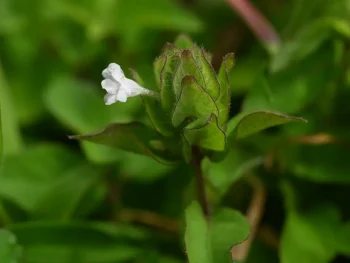
Browne’s Blechum: A Tropical Ground Cover Worth Knowing
If you’ve ever wandered through a tropical garden and spotted a low-growing plant with delicate purple flowers tucked among the greenery, you might have encountered Browne’s blechum (Ruellia blechum). This little annual forb has quite the story to tell, and whether it deserves a spot in your garden depends on where you’re gardening and what you’re hoping to achieve.
What Exactly is Browne’s Blechum?
Browne’s blechum is a small, herbaceous annual that belongs to the acanthus family. As a forb, it’s essentially an herbaceous flowering plant that lacks any significant woody growth above ground. Think of it as nature’s way of creating a living carpet – it stays low, spreads around, and produces charming little purple blooms that seem to appear almost magically among its green foliage.
You might also see this plant referred to by its various botanical synonyms, including Blechum brownei or Blechum pyramidatum, depending on which field guide or reference you’re consulting. But regardless of what name it goes by, the plant remains the same delightful little ground-hugger.
Where Does It Call Home?
Here’s where things get interesting from a native gardening perspective. Browne’s blechum is truly native to Puerto Rico and the U.S. Virgin Islands – these Caribbean islands are where it naturally belongs and has evolved alongside local ecosystems for countless generations.
However, this adaptable little plant has managed to establish itself well beyond its native range. You’ll now find it growing in Florida, Hawaii, Louisiana, Guam, and Palau, where it has successfully naturalized and reproduces on its own without human intervention.
- Species observed
- No observations
The Garden Appeal Factor
So what makes Browne’s blechum garden-worthy? Its charm lies in its understated beauty and adaptability. The plant produces small, tubular purple flowers that may be modest in size but are perfectly formed and attract butterflies and other small pollinators. Its low-growing habit makes it excellent for filling in gaps in tropical and subtropical landscapes.
As an annual, it completes its entire life cycle in one growing season, which means you’ll get flowers and then seeds for the next generation. This can be either a blessing or a challenge, depending on your gardening style – some folks love the surprise of seeing where it pops up next, while others prefer more predictable plantings.
Growing Conditions and Care
If you’re gardening in USDA hardiness zones 9-11, you’re in the sweet spot for growing Browne’s blechum successfully. This plant appreciates:
- Partial shade to filtered sunlight
- Consistently moist soil conditions
- Warm, humid climates typical of tropical and subtropical regions
- Well-draining soil that doesn’t become waterlogged
The plant’s wetland status varies depending on your region. In the Atlantic and Gulf Coastal Plain, it’s considered a facultative wetland plant, meaning it usually prefers wet conditions but can tolerate drier spots. In the Caribbean, it leans more toward upland conditions, while in Hawaii, it’s happy in either wet or dry situations.
The Native Plant Perspective
Now, here’s where your location really matters. If you’re gardening in Puerto Rico or the U.S. Virgin Islands, congratulations – you’re considering a true native that belongs in your local ecosystem. Plant away with confidence!
But if you’re anywhere else where this plant has naturalized, you’re dealing with a non-native species. While Browne’s blechum isn’t currently listed as invasive or noxious, it’s worth considering native alternatives that will provide similar benefits while supporting your local ecosystem.
For those seeking native ground covers with small purple flowers, consider researching local Ruellia species native to your specific region, or explore other native forbs that offer similar aesthetic appeal and pollinator benefits.
Planting and Care Tips
If you decide to grow Browne’s blechum, you’ll find it refreshingly low-maintenance:
- Start from seed in spring after the last frost date
- Sow seeds in moist, partially shaded areas
- Keep soil consistently moist during germination and establishment
- Once established, the plant typically self-seeds for the following year
- No fertilization needed – this plant thrives in average garden conditions
- Deadhead spent flowers if you want to prevent self-seeding
The Bottom Line
Browne’s blechum is one of those plants that fits perfectly in certain situations and gardens. If you’re creating a naturalized tropical landscape, don’t mind plants that self-seed, and appreciate subtle beauty over showstopping displays, it might be just what you’re looking for.
However, always remember the golden rule of native gardening: when in doubt, choose native. Your local wildlife will thank you, and you’ll be supporting the intricate web of relationships that make healthy ecosystems thrive. Whether you choose Browne’s blechum or seek out a native alternative, you’re taking steps toward creating a garden that’s both beautiful and ecologically meaningful.