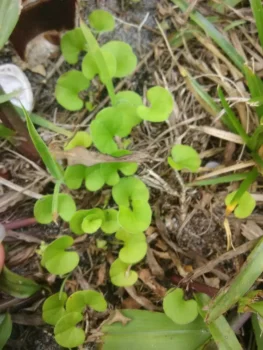
Carolina Ponysfoot: A Native Ground Cover Worth Getting to Know
If you’re tired of the endless cycle of mowing, watering, and fertilizing your traditional lawn, let me introduce you to a charming little native plant that might just change your perspective on ground cover. Meet Carolina ponysfoot (Dichondra carolinensis), a delightful perennial that’s been quietly carpeting the southeastern United States long before suburban lawns became the norm.
What is Carolina Ponysfoot?
Carolina ponysfoot is a low-growing perennial forb that creates dense, mat-like carpets across the landscape. Don’t let the forb classification intimidate you – it simply means this is a non-woody plant that lacks significant woody tissue above ground. Think of it as nature’s answer to artificial turf, but infinitely more interesting and beneficial to local ecosystems.
This little ground-hugger gets its charming common name from its small, round to kidney-shaped leaves that somewhat resemble tiny horse hooves. The botanical name, Dichondra carolinensis, pays homage to its strong presence in the Carolinas, though its range extends far beyond those borders.
Where Does Carolina Ponysfoot Call Home?
As a true native of the lower 48 states, Carolina ponysfoot has established itself across a impressive swath of the country. You’ll find this adaptable plant thriving in Alabama, Arkansas, Florida, Georgia, Illinois, Louisiana, Maryland, Mississippi, Missouri, North Carolina, Ohio, Oklahoma, Pennsylvania, South Carolina, Tennessee, Texas, and Virginia.
- Species observed
- No observations
Why Consider Carolina Ponysfoot for Your Garden?
There are several compelling reasons why this native ground cover deserves a spot in your landscape:
- Low maintenance: Once established, it requires minimal care compared to traditional turf grass
- Native plant benefits: Supports local ecosystems and requires fewer inputs than non-native alternatives
- Moisture adaptable: Its facultative wetland status means it can handle both wet and moderately dry conditions
- Dense coverage: Creates attractive, carpet-like coverage that suppresses weeds
- Unique texture: Adds visual interest with its distinctive round leaves
Perfect Garden Settings
Carolina ponysfoot shines in several landscape applications:
- Native plant gardens where you want authentic regional character
- Rain gardens and bioswales where its moisture tolerance is an asset
- Woodland edges and naturalized areas
- Ground cover in areas where traditional grass struggles
- Low-traffic lawn alternatives
Growing Conditions and Care
One of Carolina ponysfoot’s greatest strengths is its adaptability. This resilient native thrives in USDA hardiness zones 6 through 10, making it suitable for much of its natural range and beyond.
Light requirements: Carolina ponysfoot is pleasantly flexible, growing well in partial shade to full sun conditions.
Soil preferences: This plant isn’t picky about soil type and can adapt to various conditions. However, it shows a preference for moist to wet soils, which aligns with its facultative wetland status across different regions.
Water needs: While it can tolerate some drought once established, Carolina ponysfoot performs best with consistent moisture. During dry spells, occasional deep watering will keep it looking its best.
Planting and Establishment Tips
Getting Carolina ponysfoot established in your garden is relatively straightforward:
- Plant in spring or early fall for best establishment
- Space plants about 6-12 inches apart if using transplants
- Keep soil consistently moist during the first growing season
- Be patient – like many native plants, it may take a season or two to really hit its stride
- Once established, it spreads naturally by stolons (above-ground runners)
Wildlife and Ecosystem Benefits
While Carolina ponysfoot may not be a major pollinator magnet due to its tiny, inconspicuous flowers, it still contributes to the local ecosystem. As a native plant, it supports the complex web of insects, birds, and other wildlife that have evolved alongside it. The dense mat it creates also provides shelter for small creatures and helps prevent soil erosion.
A Few Things to Keep in Mind
Carolina ponysfoot is generally well-behaved in the garden, with no known invasive or noxious tendencies. However, like any spreading ground cover, it may need occasional management to keep it within desired boundaries. Its moisture-loving nature also means it might not be the best choice for xeriscapes or extremely dry locations.
The Bottom Line
If you’re looking for a native ground cover that offers low maintenance, regional authenticity, and natural charm, Carolina ponysfoot deserves serious consideration. It may not have the flashy flowers of some garden favorites, but its understated beauty and ecological benefits make it a valuable addition to naturalized landscapes and native plant gardens. Plus, there’s something deeply satisfying about working with a plant that’s been thriving in your region for centuries – it’s like welcoming an old friend into your garden.