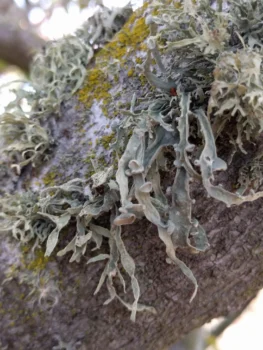
Cartilage Lichen: The Fascinating Ramalina leptocarpha in Your Garden
Have you ever noticed those crusty, branching growths on tree bark and wondered what they are? You might be looking at cartilage lichen (Ramalina leptocarpha), a remarkable organism that’s neither plant nor animal, but something wonderfully unique. Let’s dive into the fascinating world of this North American native and discover why you should appreciate these often-overlooked garden residents.
What Exactly Is Cartilage Lichen?
Cartilage lichen belongs to a group of organisms called lichens, which are actually a partnership between fungi and algae working together in perfect harmony. Think of it as nature’s ultimate roommate situation – the fungus provides structure and protection, while the algae produces food through photosynthesis. This teamwork creates the unique, often colorful growths we see clinging to trees, rocks, and other surfaces.
Also known by its scientific synonym Ramalina menziesii, cartilage lichen is native to North America, making it a natural part of our continent’s ecological tapestry.
Where You’ll Find Cartilage Lichen
As a native North American species, cartilage lichen has adapted to various environments across the continent. While specific distribution details for this particular species aren’t well-documented, lichens in the Ramalina genus typically favor areas with good air quality and appropriate moisture levels.
Is Cartilage Lichen Beneficial for Your Garden?
Absolutely! While you can’t exactly plant cartilage lichen like you would a flower or shrub, its presence in your garden is actually a wonderful sign. Here’s why you should celebrate finding it:
- Air quality indicator: Lichens are sensitive to air pollution, so their presence suggests you have clean, healthy air in your garden
- Ecological value: They provide food and nesting materials for various wildlife species
- Natural beauty: Lichens add unique textures and subtle colors to tree bark and garden surfaces
- Low maintenance: They require absolutely no care from you – they’re the ultimate low-maintenance garden residents
How to Identify Cartilage Lichen
Spotting cartilage lichen requires a keen eye, as lichens can be quite subtle. Look for these characteristics:
- Growing on tree bark, rocks, or other hard surfaces
- Has a somewhat crusty or branching appearance
- Typically grows in patches or colonies
- May appear grayish, greenish, or have other muted tones
- Feels dry and somewhat brittle to the touch
Remember, lichens grow very slowly, so what you’re seeing has likely been developing for years or even decades!
Creating a Lichen-Friendly Garden
While you can’t plant lichens directly, you can create conditions that encourage their natural establishment:
- Avoid chemical treatments: Skip pesticides and fungicides that might harm these sensitive organisms
- Maintain good air quality: Avoid burning materials or using harsh chemicals near areas where lichens grow
- Leave natural surfaces: Don’t scrub or power-wash tree bark where lichens are growing
- Be patient: Lichens establish themselves naturally over time – there’s no rushing the process
The Bottom Line
Cartilage lichen might not be the showiest resident of your garden, but it’s certainly one of the most fascinating. These remarkable organisms serve as living indicators of environmental health while adding their own quiet beauty to the landscape. Rather than trying to remove them, celebrate their presence as a sign that your garden is supporting diverse, native life forms.
Next time you’re wandering through your garden, take a moment to appreciate these amazing partnerships between fungi and algae. They’re a reminder that some of nature’s most incredible collaborations happen right under our noses – or in this case, right on our trees!