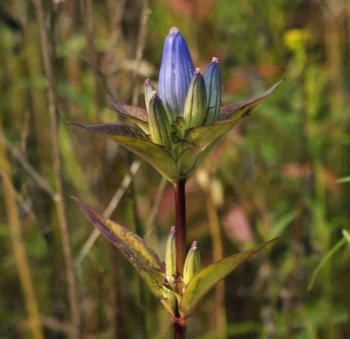
Closed Bottle Gentian: The Mysterious Native That Bumblebees Adore
Have you ever seen a flower that seems to have forgotten how to open? Meet the Closed Bottle Gentian (Gentiana andrewsii), one of North America’s most intriguing native wildflowers. This fascinating perennial challenges everything we think we know about how flowers should behave, yet it’s perfectly designed for its specialized pollinators.
What Makes Closed Bottle Gentian Special
The Closed Bottle Gentian is a native North American perennial that brings a touch of mystery to any garden. Unlike most flowers that open wide to attract pollinators, this plant’s deep purple-blue blooms remain tightly closed, resembling small bottles or urns. The flowers appear in late summer through fall, providing crucial late-season color when many other natives have finished blooming.
This unique forb (a non-woody flowering plant) grows as an upright bunch, reaching about 2 feet tall at maturity. Its fine-textured green foliage creates an attractive backdrop for the striking purple blooms, and the plant becomes particularly conspicuous in fall when those mysterious bottle-shaped flowers take center stage.
Where It Calls Home
Closed Bottle Gentian is native to both Canada and the lower 48 states, with a impressive geographic range spanning from Manitoba and Ontario in the north, down through the Great Plains, and across the eastern United States. You can find this plant naturally growing in states including Colorado, Connecticut, Delaware, Illinois, Indiana, Iowa, Kentucky, Maryland, Massachusetts, Michigan, Minnesota, Missouri, Nebraska, New Hampshire, New Jersey, New York, North Dakota, Ohio, Pennsylvania, Rhode Island, South Dakota, Vermont, Virginia, West Virginia, and Wisconsin.
- Species observed
- No observations
The Perfect Garden Roles
This versatile native serves multiple purposes in landscape design:
- Late-season interest: Provides crucial fall color when most gardens are winding down
- Rain garden star: Its facultative wetland status makes it perfect for moisture-retentive areas
- Meadow naturalizing: Excellent for creating authentic native plant communities
- Pollinator specialist: Supports bumblebees with its unique closed-flower system
- Accent plant: The unusual flower form creates conversation-worthy focal points
A Flower with a Secret
Here’s where things get really interesting: those closed flowers aren’t actually broken or shy. They’re specifically designed for bumblebees! Only these robust pollinators are strong enough to force their way between the tightly closed petals to reach the nectar inside. It’s like nature’s own exclusive club, and bumblebees have the only membership cards.
This specialized relationship means that while your garden might not buzz with every type of pollinator around these blooms, the bumblebees that do visit will be absolutely devoted to them.
Growing Conditions That Make It Happy
Closed Bottle Gentian is surprisingly specific about its growing preferences, but once you understand what it needs, it’s quite manageable:
- Soil: Prefers medium-textured soils with high fertility requirements
- Moisture: Loves consistent moisture – think of it as preferring feet wet, head dry conditions
- Light: Tolerates intermediate shade but also does well in full sun with adequate moisture
- pH: Prefers slightly acidic to neutral soils (pH 5.8-7.2)
- Hardiness: Thrives in USDA zones 3-8, handling temperatures down to -38°F
Planting and Care Tips
Growing Closed Bottle Gentian requires patience but pays off with years of unique beauty:
- Starting from seed: The easiest propagation method, though seeds need stratification and have low initial vigor
- Be patient: This plant has a slow growth rate and takes time to establish
- Consistent moisture: Never let it completely dry out, especially during its active growing period from spring through fall
- Fertility matters: Unlike many natives, this plant appreciates rich, fertile soil
- Minimal maintenance: Once established, it’s fairly low-maintenance with a moderate lifespan
Why Your Garden Needs This Mysterious Beauty
Closed Bottle Gentian offers something truly special for native plant enthusiasts. It extends your garden’s blooming season well into fall, supports specialized native pollinators, and provides an unusual conversation piece that’s guaranteed to intrigue visitors. While it may not be the easiest native to establish, its moderate growth rate and unique characteristics make it worth the effort for gardeners looking to create authentic, biodiverse landscapes.
Plus, there’s something deeply satisfying about successfully growing a plant with such specific needs – it’s like earning a badge of honor in the native gardening community!
Whether you’re creating a rain garden, naturalizing a meadow, or simply want to add some late-season mystery to your native plant border, Closed Bottle Gentian deserves serious consideration. Just remember to be patient with its establishment and keep those bumblebees in mind when planning your garden’s pollinator strategy.