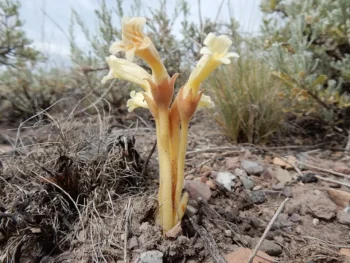
Clustered Broomrape: The Mysterious Parasitic Wildflower You Can’t (And Shouldn’t) Grow
Have you ever stumbled across a strange, yellowish plant that looks like it belongs in a sci-fi movie rather than your backyard? You might have encountered clustered broomrape (Orobanche fasciculata), one of nature’s most unusual characters. This quirky native plant has a lifestyle that would make even the most dramatic soap opera seem tame – it’s a full-time plant parasite!
What Exactly Is Clustered Broomrape?
Clustered broomrape is an annual parasitic plant native to North America. Unlike your typical garden flowers that make their own food through photosynthesis, this sneaky little plant has given up that whole making your own living thing. Instead, it latches onto the roots of other plants and steals their nutrients. Talk about being a freeloader!
As a forb (that’s fancy talk for a non-woody herbaceous plant), clustered broomrape lacks the green chlorophyll that most plants use to make food. Instead, it sports yellowish to purplish stems topped with small, scale-like leaves and tiny flowers that cluster together – hence the clustered part of its name.
Where Does Clustered Broomrape Call Home?
This parasitic plant has quite the extensive native range across North America. You can find it naturally growing in Alaska, throughout Canada, and across most of the western United States, with its range extending into some central and even a few eastern states. It’s native to: Alberta, British Columbia, Alaska, Manitoba, Arizona, California, Ontario, Colorado, Saskatchewan, Yukon, Idaho, Illinois, Indiana, Iowa, Kansas, Michigan, Minnesota, Montana, Nebraska, Nevada, New Mexico, North Dakota, Oklahoma, Oregon, South Dakota, Texas, Utah, Washington, Wisconsin, and Wyoming.
- Species observed
- No observations
Why You Can’t Grow Clustered Broomrape (And Why You Wouldn’t Want To)
Here’s where things get interesting for us gardeners: you simply cannot cultivate clustered broomrape in your garden, and honestly, you wouldn’t want to anyway. Here’s why:
- It’s a parasite: This plant cannot survive without specific host plants to parasitize. It literally cannot live on its own.
- No aesthetic value: Let’s be honest – it’s not winning any beauty contests. The small, inconspicuous flowers and yellowish stems aren’t exactly what most gardeners dream of.
- Unpredictable behavior: Since it depends entirely on host plants, you never know where it might show up or how it might affect your other plants.
- Minimal wildlife benefits: Unlike many native plants that support pollinators and wildlife, clustered broomrape offers little in terms of ecological garden benefits.
The Role of Clustered Broomrape in Nature
Before you start thinking this plant is just a botanical villain, remember that clustered broomrape has been part of North American ecosystems for thousands of years. In the wild, it plays a role in plant community dynamics and has co-evolved with its host plants. It’s fascinating from an ecological perspective, even if it’s not garden-worthy.
The plant typically parasitizes members of the sunflower family (Asteraceae) and other herbaceous plants, forming connections with their root systems to tap into their nutrient supply.
What to Do If You Spot Clustered Broomrape
If you encounter this unusual plant during your nature walks or even in wilder areas of your property, consider yourself lucky to witness one of nature’s more unusual strategies for survival. Take a photo, observe its interesting lifestyle, but leave it be – it’s doing its part in the natural ecosystem.
For your garden, stick with the many beautiful native plants that you can actually cultivate successfully and that will provide real benefits to pollinators and wildlife. Your local native plant society can recommend stunning alternatives that will thrive in your specific growing conditions and support your local ecosystem in positive ways.
The Bottom Line
Clustered broomrape is one of those plants that’s better admired from a distance and left to do its thing in wild spaces. While it’s a fascinating example of how diverse and creative nature can be, it’s definitely not destined for garden life. Instead, appreciate it as a unique piece of our native plant heritage – one that reminds us that the plant world is far more complex and interesting than we might imagine!