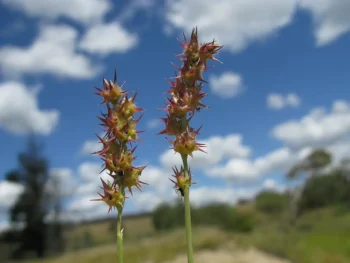
Coastal Sandbur: A Native Grass That’s Better Admired Than Planted
Meet coastal sandbur (Cenchrus spinifex), a native grass that perfectly embodies the saying not all natives are garden-friendly. While this scrappy little grass plays an important role in American ecosystems, it’s probably not the plant you want to invite into your backyard barbecue area. Let me explain why this prickly character might be better appreciated from a distance.
What Exactly Is Coastal Sandbur?
Coastal sandbur, scientifically known as Cenchrus spinifex, is a native grass that can be either annual or perennial depending on growing conditions. You might also encounter it under its former scientific names like Cenchrus incertus, Cenchrus parviceps, or Cenchrus pauciflorus – botanists have been shuffling this plant around the naming game for years!
This grass belongs to the graminoid family, meaning it’s a true grass with all the typical grass characteristics. But unlike your lawn grass, coastal sandbur comes equipped with some serious attitude in the form of spiny seed heads that can make walking barefoot a memorable (and painful) experience.
Where Does Coastal Sandbur Call Home?
This hardy native has claimed territory across a huge swath of the United States, from coast to coast. You’ll find coastal sandbur growing naturally in Alabama, Arizona, Arkansas, California, District of Columbia, Florida, Georgia, Kansas, Kentucky, Louisiana, Maine, Maryland, Massachusetts, Mississippi, Nevada, New Mexico, North Carolina, Oklahoma, South Carolina, Tennessee, Texas, Vermont, Virginia, Puerto Rico, and the U.S. Virgin Islands. That’s quite the impressive range for such a small plant!
- Species observed
- No observations
The plant thrives in sandy, disturbed soils and is particularly common along coastlines (hence the name), roadsides, vacant lots, and other areas where the soil has been disrupted.
Should You Plant Coastal Sandbur in Your Garden?
Here’s where I need to be straight with you: while coastal sandbur is undeniably native and has its place in the ecosystem, it’s not what most people would call garden-friendly. Here’s why:
The Challenges
- Ouch factor: Those spiny seed heads (called burs) are designed by nature to stick to anything that passes by – including your socks, pet fur, and bare feet
- Aggressive spread: This grass can quickly take over areas where it’s happy
- Limited beauty: Let’s be honest – it’s not winning any beauty contests with its coarse appearance
- Maintenance headaches: Once established, it can be difficult to remove if you change your mind
Growing Conditions (If You’re Determined)
If you’re still interested in coastal sandbur despite the warnings – perhaps for a naturalized area or erosion control project – here’s what it needs:
- Soil: Sandy, well-draining soil (it actually prefers poor, disturbed soils)
- Sun: Full sun exposure
- Water: Very drought tolerant once established
- Climate: Adaptable to USDA zones 6-11 depending on your location
Better Native Alternatives
Instead of coastal sandbur, consider these native grasses that offer similar ecological benefits without the painful drawbacks:
- Little bluestem – Beautiful fall color and wildlife value
- Buffalo grass – Great for drought-prone areas
- Blue grama grass – Attractive seed heads that won’t attack your ankles
- Switchgrass – Tall, elegant, and excellent for wildlife
The Bottom Line
Coastal sandbur earns respect as a tough native plant that can grow where others fear to tread. It provides some wildlife benefits through its seeds and helps prevent erosion in challenging sites. However, unless you have a very specific need for erosion control in a remote area where foot traffic isn’t a concern, you’re probably better off choosing a more garden-friendly native grass.
Sometimes the best way to appreciate a native plant is to admire its tenacity and ecological role while keeping it at arm’s length from your garden beds. Coastal sandbur falls squarely into this category – a fascinating native that’s best left to do its important work in wild spaces rather than cultivated ones.