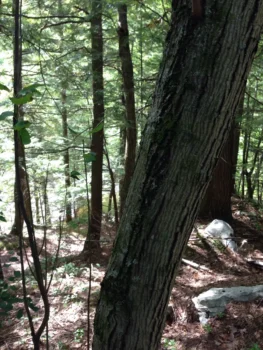
Common Serviceberry: A Native Gem That Delivers Year-Round Beauty
If you’re looking for a native tree that works overtime in your landscape, meet the common serviceberry (Amelanchier arborea). This unsung hero of North American forests brings a delightful combination of spring flowers, summer fruit, and spectacular fall color—all while supporting local wildlife. Let’s explore why this versatile native deserves a spot in your garden.
What Is Common Serviceberry?
Common serviceberry is a perennial, multi-stemmed woody plant that typically grows as a large shrub or small tree. Despite being classified as a shrub, it can reach impressive heights of up to 36 feet at maturity, though it usually stays closer to 13-16 feet in most garden settings. With its slow but steady growth rate, you can expect it to reach about 25 feet in 20 years.
This native beauty has an erect, single-stem growth form and develops a lovely open canopy as it matures. Its fine-textured, dark green foliage creates a dense summer backdrop that becomes delightfully porous in winter, allowing light to filter through to understory plants.
Where Common Serviceberry Calls Home
As a true North American native, common serviceberry has an impressive natural range. You’ll find this adaptable species growing wild from southeastern Canada (including New Brunswick, Nova Scotia, Ontario, and Quebec) all the way down to northern Florida. Its distribution stretches west through the Great Plains to Minnesota, Iowa, Kansas, Nebraska, and eastern Texas, covering nearly 40 states in total.
- Species observed
- No observations
This extensive native range means common serviceberry is well-adapted to a variety of growing conditions across much of the continental United States and southeastern Canada.
Why Your Garden Will Love Common Serviceberry
Common serviceberry is like that friend who always shows up with something delightful—it offers multiple seasons of interest that make it a standout choice for native gardeners.
Spring Spectacle
In mid-spring, before the leaves fully emerge, common serviceberry bursts into bloom with clusters of conspicuous white flowers. These delicate blooms create a stunning display and provide crucial early-season nectar for bees, butterflies, and other pollinators when few other flowers are available.
Summer Harvest
By summer, those lovely flowers transform into conspicuous red berries that eventually ripen to blue-purple. These fruits aren’t just beautiful—they’re edible and quite tasty, with a sweet flavor that’s perfect for jams, pies, or eating fresh off the tree.
Fall Drama
Come autumn, common serviceberry really puts on a show with conspicuous fall foliage in brilliant yellows, oranges, and reds. This reliable fall color makes it a valuable addition to any landscape focused on seasonal interest.
Perfect Garden Roles
Common serviceberry excels in several landscape situations:
- Woodland gardens: Its shade tolerance makes it perfect for understory planting
- Native plant gardens: A cornerstone species that supports local ecosystems
- Wildlife gardens: The berries feed birds while flowers support pollinators
- Naturalized areas: Excellent for creating natural-looking plantings
- Specimen planting: Beautiful enough to stand alone as a focal point
Growing Conditions and Care
One of the best things about common serviceberry is its adaptability, though it does have some preferences that will help it thrive.
Soil Requirements
Common serviceberry prefers well-drained soils and adapts well to both coarse and medium-textured soils, though it struggles in heavy clay. It thrives in slightly acidic to neutral conditions (pH 4.8-7.5) and has medium fertility requirements—no need to over-fertilize this modest native.
Light and Water
This shade-tolerant species does well in partial sun to partial shade conditions. While it has low drought tolerance once established, it also handles medium moisture levels well. It’s not particularly suited for very wet areas, typically occurring in non-wetlands though it can occasionally tolerate wetland conditions.
Climate Adaptability
Hardy in USDA zones 4-9, common serviceberry can handle minimum temperatures down to -47°F and needs at least 120 frost-free days. It requires 26-80 inches of annual precipitation, making it suitable for a wide range of climates.
Planting and Establishment Tips
Getting your common serviceberry off to a good start is straightforward:
- Timing: Plant in early spring or fall when temperatures are moderate
- Location: Choose a spot with partial shade and good drainage
- Spacing: Allow 700-1,700 plants per acre for mass plantings, or provide adequate space for a single specimen
- Root depth: Ensure soil is workable to at least 20 inches deep
- Cold stratification: If growing from seed, cold stratification is required for germination
Propagation Options
Common serviceberry can be propagated through several methods including bare root planting, container growing, cuttings, and seeds. Seeds are quite small (nearly 80,000 per pound!) and have moderate abundance and spread rate.
Long-term Care
Once established, common serviceberry is relatively low-maintenance. It has good resprout ability if damaged and moderate fire tolerance. The species has a moderate lifespan and doesn’t require special care beyond occasional pruning to maintain shape if desired.
Keep in mind that this isn’t a plant for formal hedges—it has low hedge tolerance and prefers to grow in its natural form. It’s also not allelopathic, meaning it won’t inhibit the growth of nearby plants.
Wildlife and Ecological Benefits
Beyond its garden appeal, common serviceberry is an ecological powerhouse. The early spring flowers provide critical nectar resources for pollinators emerging from winter, while the summer berries feed numerous bird species. This native species supports the complex web of relationships that make healthy ecosystems function.
Is Common Serviceberry Right for Your Garden?
Common serviceberry is an excellent choice if you:
- Want a low-maintenance native tree with multi-season interest
- Are creating habitat for wildlife and pollinators
- Have partial shade conditions
- Appreciate edible landscaping
- Live in USDA zones 4-9
This might not be your plant if you need something for full sun, very wet conditions, or formal landscaping situations.
With its combination of beauty, ecological value, and easy care, common serviceberry proves that native plants can deliver everything gardeners want while supporting the natural world around us. Consider adding this North American treasure to your landscape—your garden (and local wildlife) will thank you!