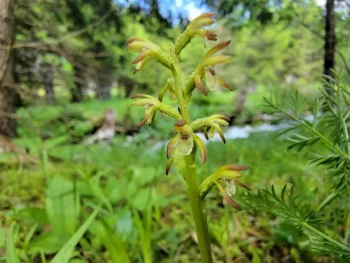
Coralroot: The Mysterious Leafless Orchid That’s Better Left Wild
If you’ve ever stumbled across a peculiar leafless spike of flowers rising from the forest floor and wondered what on earth you were looking at, you might have encountered a coralroot orchid (Corallorhiza). These fascinating native perennials are some of North America’s most unusual wildflowers, but before you start planning to add them to your garden, there’s quite a story to tell about why these mysterious orchids are best admired from a distance.
What Makes Coralroot So Special?
Coralroot orchids are botanical rebels that have thrown the conventional plant playbook out the window. Unlike typical plants that produce their own food through photosynthesis, coralroots have evolved to live as parasites, stealing nutrients from fungi in the soil. This lifestyle has allowed them to ditch their leaves entirely – they simply don’t need them! Instead, they produce distinctive coral-like underground rhizomes (hence the name) and send up leafless flowering spikes that can range from subtle yellows and browns to striking purples and whites.
As herbaceous perennials, coralroots die back to their underground parts each winter and emerge again the following growing season, though they may skip years entirely if conditions aren’t quite right.
Where Coralroots Call Home
These remarkable orchids are true North American natives, naturally occurring across an impressively wide range that includes Alaska, Canada, Greenland, all of the lower 48 states, and even St. Pierre and Miquelon. You can find various coralroot species from coast to coast, spanning from Alberta and British Columbia down to Florida and California, and everywhere in between – including all the Canadian provinces and territories, plus dozens of U.S. states.
- Species observed
- No observations
The Hard Truth About Growing Coralroot
Here’s where we need to have an honest conversation: coralroots are virtually impossible for home gardeners to cultivate successfully. Their parasitic relationship with specific soil fungi makes them incredibly challenging to establish and maintain outside their natural habitat. Even experienced orchid growers typically avoid attempting to grow coralroots because the success rate is so dismally low.
Why coralroots don’t work in typical gardens:
- They require specific mycorrhizal fungi that are difficult to replicate in garden settings
- Without their fungal partners, they cannot obtain nutrients and will quickly die
- They have very specific soil chemistry and moisture requirements
- Commercial propagation is extremely limited due to these complications
- Transplanting wild specimens is both ineffective and ecologically harmful
Appreciating Coralroots the Right Way
Instead of trying to grow coralroots in your garden, consider these alternatives for enjoying these fascinating plants:
In the wild: Learn to identify and appreciate coralroots during woodland hikes. They’re often found in mature forests with rich, undisturbed soil and established fungal networks.
Photography and observation: Coralroots make excellent subjects for nature photography and botanical study. Their unusual appearance and interesting ecology provide plenty of material for plant enthusiasts.
Garden alternatives: If you’re drawn to unusual native orchids, consider other species that are more garden-friendly, such as lady slippers or native terrestrial orchids that don’t have parasitic lifestyles.
Creating Habitat Instead
While you can’t easily grow coralroots themselves, you can create conditions that might naturally support them over time. Focus on:
- Preserving existing mature woodland areas on your property
- Avoiding soil disturbance in forested areas
- Maintaining natural leaf litter and organic matter
- Planting other native woodland plants that support healthy soil ecosystems
The Bottom Line
Coralroots are absolutely fascinating native plants that showcase the incredible diversity of North American orchids. However, they’re best appreciated as wild treasures rather than garden additions. Their complex ecological requirements make successful cultivation nearly impossible for home gardeners, and attempting to transplant wild specimens is both likely to fail and potentially harmful to wild populations.
Instead of trying to bring coralroots to your garden, let your garden inspire you to seek out these remarkable orchids in their natural woodland homes. Sometimes the most meaningful way to connect with native plants is simply to observe and appreciate them where they thrive naturally – and coralroots definitely fall into that category!