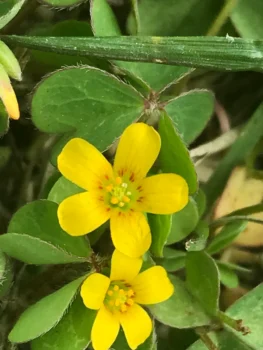
Creeping Woodsorrel: The Little Yellow Wildflower You’ve Probably Already Met
If you’ve ever spotted tiny yellow flowers peeking out from sidewalk cracks or noticed heart-shaped leaves carpeting a shady corner of your garden, chances are you’ve encountered creeping woodsorrel (Oxalis corniculata). This humble little plant, also known as yellow wood sorrel or by its Hawaiian name ihi ‘ai, is one of those fascinating species that seems to pop up everywhere – and for good reason.
What Is Creeping Woodsorrel?
Creeping woodsorrel is a low-growing forb – essentially a non-woody plant that hugs the ground and spreads outward rather than reaching for the sky. As both an annual and perennial (depending on growing conditions), this adaptable little character can complete its life cycle in one season or stick around for years, making itself quite at home in a variety of settings.
The plant gets its creeping moniker from its growth habit of spreading along the ground via stolons, creating dense mats of distinctive three-leaflet foliage. Each leaf looks like a tiny shamrock, and the bright yellow flowers, though small, add cheerful splashes of color from spring through fall.
Where You’ll Find It Growing
Here’s where things get interesting: creeping woodsorrel has a complex relationship with North American geography. It’s actually native to the lower 48 states, Puerto Rico, and the U.S. Virgin Islands, but it’s considered non-native (though naturalized) in Canada, Hawaii, and other Pacific regions. Talk about a well-traveled plant!
You can find creeping woodsorrel growing wild across an impressive range of locations, from Alabama to Wyoming, and from British Columbia to Guam. It’s established in virtually every U.S. state and several Canadian provinces, plus various territories and islands.
- Species observed
- No observations
The Garden Reality Check
Let’s be honest – most gardeners don’t intentionally plant creeping woodsorrel. It’s more likely to plant itself in your garden! This self-sufficient little plant has a knack for showing up uninvited and making itself comfortable in flower beds, lawn edges, and anywhere there’s a bit of bare soil.
But before you write it off entirely, consider this: creeping woodsorrel does have some redeeming qualities. Its mat-forming habit can help prevent soil erosion, and those cheerful yellow flowers do attract small pollinators like tiny bees and flies. The leaves are also edible (they have a tart, lemony flavor), though they should be eaten in moderation.
Growing Conditions and Hardiness
One of the reasons creeping woodsorrel is so widespread is its remarkable adaptability. This plant is hardy in USDA zones 4-11, which covers most of the continental United States and beyond. It’s particularly fond of:
- Moist, fertile soils (but will tolerate poor conditions)
- Partial shade to full sun
- Areas with consistent moisture
- Disturbed soils where competition is minimal
According to wetland classifications, creeping woodsorrel is generally considered facultative upland in most regions, meaning it usually prefers non-wetland areas but can tolerate some moisture. Only in the Atlantic and Gulf Coastal Plain is it classified as obligate upland, almost never occurring in true wetlands.
If You’re Thinking About Growing It
While creeping woodsorrel isn’t typically sold at nurseries, it’s so good at self-sowing that you probably won’t need to actively plant it. If it shows up in your garden naturally, you can choose to let it be in informal areas where its spreading habit won’t compete with prized plantings.
However, if you’re looking for native ground cover options, consider these alternatives that might serve your landscape better:
- Wild ginger (Asarum canadense) for shady areas
- Creeping phlox (Phlox subulata) for sunny slopes
- Wild strawberry (Fragaria virginiana) for edible ground cover
- Partridgeberry (Mitchella repens) for woodland gardens
Managing Creeping Woodsorrel
If creeping woodsorrel becomes too enthusiastic in your garden, it’s relatively easy to manage. The shallow root system makes it simple to pull by hand, especially when the soil is moist. Regular mowing will also keep it in check in lawn areas.
Remember, this plant spreads both by seed and by creeping stems, so removing it before it flowers and sets seed will help prevent further spread.
The Bottom Line
Creeping woodsorrel is one of those plants that exists in the gray area between wildflower and weed. Whether you see it as friend or foe largely depends on where it decides to grow and how you feel about uninvited garden guests. While it’s not typically something you’d purchase and plant intentionally, there’s something to be said for a little plant that’s so determined to bring a touch of yellow sunshine to the world – even if it does so without asking permission first!