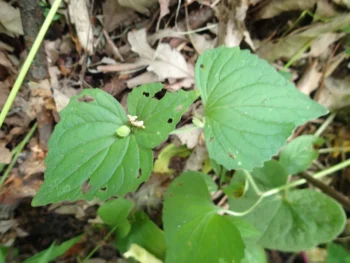
Creepingroot Violet: A Charming Native Groundcover for Shady Spaces
If you’re looking for a delicate, low-maintenance native plant to brighten up those shadier corners of your garden, the creepingroot violet might just be your new best friend. This unassuming little perennial packs a surprising punch when it comes to both beauty and ecological benefits.
What Makes Creepingroot Violet Special?
Known botanically as Viola canadensis var. rugulosa, the creepingroot violet is a charming native forb that brings subtle elegance to any landscape. As a perennial, this hardy little plant will return year after year, gradually spreading to form a lovely groundcover that’s both practical and pretty.
You might also see this plant listed under its synonyms: Viola canadensis ssp. rydbergii, Viola rugulosa, or Viola rydbergii. Don’t let the scientific names intimidate you – they’re all referring to the same wonderful plant!
Where Does It Call Home?
This violet is a true North American native with an impressively wide range. You’ll find it growing naturally from Alaska all the way down to New Mexico, and from the Pacific Northwest clear across to the Great Lakes region. It thrives in states including Alberta, British Columbia, Alaska, Manitoba, Arizona, Ontario, Colorado, Saskatchewan, Idaho, Illinois, Iowa, Minnesota, Montana, Nebraska, North Dakota, Oregon, South Dakota, Utah, Washington, Wisconsin, and Wyoming.
- Species observed
- No observations
Why Plant Creepingroot Violet in Your Garden?
There are several compelling reasons to give this native violet a spot in your landscape:
- Native benefits: As a true native, it supports local ecosystems and requires less water and maintenance once established
- Low maintenance: Once settled in, this perennial is pretty much self-sufficient
- Pollinator friendly: Small native pollinators appreciate the modest flowers
- Wildlife support: Native violets often serve as host plants for butterfly larvae
- Adaptable: With such a wide natural range, it’s clearly a flexible plant
What to Expect in Your Garden
As a forb (basically a non-woody flowering plant), creepingroot violet stays close to the ground and spreads gradually. The creeping in its name gives you a hint – this plant will slowly expand its territory through underground roots, making it an excellent choice for naturalizing areas or filling in gaps in shaded spaces.
The delicate flowers and heart-shaped leaves typical of violets add a woodland charm that pairs beautifully with other native shade plants like wild ginger, ferns, or trilliums.
Growing Conditions and Care
While specific growing requirements for this variety can be somewhat elusive in gardening literature, violets as a group are generally quite accommodating. Based on its wide natural distribution, creepingroot violet likely appreciates:
- Light: Partial to full shade (perfect for those tricky spots under trees)
- Soil: Moist, well-draining soil with some organic matter
- Water: Regular moisture, but not soggy conditions
- Climate: Hardy across a wide range of zones, likely USDA zones 3-8
Garden Design Ideas
Creepingroot violet works beautifully in several garden settings:
- Woodland gardens: Perfect companion for other native shade lovers
- Naturalized areas: Let it spread and do its thing in wilder spaces
- Under trees: Excellent for those challenging spots where grass won’t grow
- Native plant gardens: A must-have for authentic regional plantings
A Few Things to Keep in Mind
While creepingroot violet is generally well-behaved, remember that it does spread via underground roots. This makes it fantastic for groundcover, but you’ll want to give it appropriate space or be prepared to manage its boundaries if you prefer a more controlled look.
Like many native plants, specific cultivation information can be harder to find than for common garden center plants. Don’t let this discourage you – native plants are often easier to grow than their more pampered cousins once you understand their basic needs.
The Bottom Line
Creepingroot violet may not be the showiest plant in the garden, but it’s exactly the kind of steady, reliable native that forms the backbone of a healthy, sustainable landscape. Its wide natural range suggests it’s adaptable and tough, while its native status means it’s supporting local wildlife in ways that non-native plants simply can’t match.
If you’re building a native plant garden, naturalizing a shady area, or just looking for something different to try in those challenging spots, creepingroot violet deserves serious consideration. Sometimes the most humble plants turn out to be the most rewarding!