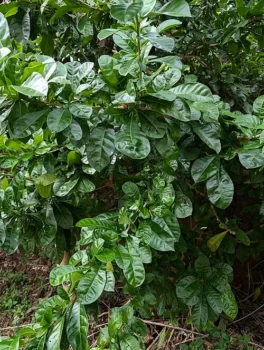
Crescentia: The Mysterious Calabash Plant Worth Considering
If you’ve stumbled across the name Crescentia in your plant research, you’ve discovered something quite intriguing! This perennial shrub has a complex story that makes it both fascinating and a bit puzzling for gardeners looking to add something unique to their landscape.
What Exactly is Crescentia?
Crescentia is a perennial, multi-stemmed woody shrub that typically stays under 13-16 feet in height. Like many shrubs, it usually develops several stems from or near the ground, though environmental conditions can sometimes encourage it to grow taller or develop a single main stem. This adaptability is part of what makes Crescentia an interesting addition to the right garden setting.
Where Does Crescentia Call Home?
Here’s where things get interesting – Crescentia has a somewhat complex native status that reflects the intricate relationships between plants and geography. This species is native to parts of the lower 48 United States and the U.S. Virgin Islands. However, it’s also found as a non-native species that reproduces naturally in parts of the Pacific Basin. Currently, you can find Crescentia growing in Florida, Palau, Puerto Rico, and the Virgin Islands.
- Species observed
- No observations
Should You Plant Crescentia in Your Garden?
The decision to plant Crescentia depends largely on your location and garden goals. If you’re in an area where it’s native (like parts of Florida or the Virgin Islands), you’re supporting local ecosystems by choosing this plant. Its shrub form makes it versatile for various landscape roles, from providing structure to serving as a backdrop for smaller plants.
However, if you’re in an area where Crescentia isn’t native, you might want to consider native alternatives that provide similar benefits to local wildlife and ecosystems. While there’s no indication that Crescentia is invasive or problematic, choosing native plants is generally the most environmentally responsible approach.
Growing Crescentia Successfully
Unfortunately, specific growing requirements for Crescentia aren’t well-documented in available resources, which means you’ll need to do some experimentation if you choose to grow this plant. As a perennial shrub, it will return year after year once established, making it a good long-term investment for your landscape.
Here are some general guidelines for shrub care that likely apply:
- Provide adequate space for the plant to develop its natural multi-stemmed form
- Consider the mature size (potentially up to 16 feet) when choosing a planting location
- Monitor the plant’s response to your local conditions and adjust care accordingly
- Be patient – as a perennial, it may take time to establish and reach its full potential
The Bottom Line
Crescentia presents an intriguing option for gardeners who appreciate unique plants with interesting growth habits. Its shrub form offers versatility in landscape design, and its perennial nature means you’re making a long-term addition to your garden. While specific care information is limited, this can also be seen as an opportunity for adventurous gardeners to learn through observation and experimentation.
If you’re in an area where Crescentia is native, it could be a wonderful way to support local plant communities. If not, consider researching native shrub alternatives that might provide similar aesthetic and ecological benefits while supporting your local ecosystem.