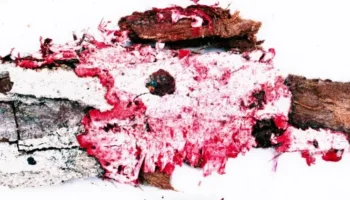
Cryptothecia rubrocincta: The Colorful Lichen Adding Natural Art to Your Trees
Have you ever noticed those crusty, colorful patches growing on tree bark in your garden and wondered what they were? If you live in a warm, humid climate, you might be looking at Cryptothecia rubrocincta, a fascinating lichen that’s been quietly decorating trees across the Americas for centuries.
What Exactly Is This Mysterious Organism?
Before we dive in, let’s clear up what we’re dealing with here. Cryptothecia rubrocincta isn’t a plant in the traditional sense – it’s actually a lichen! Lichens are remarkable organisms that represent a partnership between fungi and algae (or sometimes cyanobacteria). Think of them as nature’s ultimate roommates, working together to create something neither could achieve alone.
This particular lichen is what scientists call a crustose lichen, meaning it forms a crusty layer that’s tightly attached to its host surface – in this case, tree bark. You might also see it referred to by its scientific synonyms: Chiodecton rubrocinctum, Chiodecton sanguineum, or Herpothallon sanguineum, but don’t worry about memorizing those tongue-twisters!
Where You’ll Find This Natural Artist
Cryptothecia rubrocincta is native to North America, specifically thriving in the tropical and subtropical regions. You’re most likely to spot it in the southeastern United States, throughout the Caribbean, and down into Central and South America. It loves warm, humid climates where it can soak up moisture from the air.
Identifying Your Bark-Dwelling Visitor
So how do you know if you’ve got Cryptothecia rubrocincta decorating your trees? Here are the telltale signs to look for:
- Thin, crusty patches that seem painted directly onto tree bark
- Distinctive reddish-orange margins around the reproductive structures
- Overall grayish or whitish coloration with those characteristic colorful edges
- Smooth, relatively flat surface that follows the contours of the bark
- Typically found on the bark of various tree species
The reddish-orange borders are really the star of the show – they’re what make this lichen stand out from its more monotone cousins.
Is It Good for Your Garden?
Here’s some great news: if you find Cryptothecia rubrocincta growing in your garden, it’s actually a positive sign! Lichens are incredibly sensitive to air pollution, so their presence indicates that your local air quality is pretty good. They’re like natural air quality monitors that work for free.
This lichen won’t harm your trees – it’s simply using the bark as a place to live, not as a food source. It’s what we call an epiphyte, meaning it grows on other plants without parasitizing them. Think of it as nature’s graffiti, but the good kind that actually benefits the environment.
The Reality About Growing Lichens
Here’s where we need to set expectations: you can’t really plant or grow Cryptothecia rubrocincta in the traditional gardening sense. Lichens establish themselves naturally when conditions are right, and they grow incredibly slowly – we’re talking millimeters per year, not inches!
If you want to encourage lichens in your garden, the best approach is to:
- Maintain good air quality (avoid excessive pesticide use)
- Keep your garden relatively humid if possible
- Avoid scrubbing or cleaning tree bark unnecessarily
- Be patient – lichens will appear when they’re ready
Living in Harmony with Your Lichen Neighbors
The best thing you can do for Cryptothecia rubrocincta and other lichens is simply to leave them alone. They’re not hurting anything, they’re contributing to biodiversity, and they’re adding unique natural beauty to your landscape. Plus, they’re conversation starters – how many people can say they have living art growing on their trees?
If you’re lucky enough to spot this colorful lichen in your garden, take a moment to appreciate the incredible biological partnership you’re witnessing. It’s a reminder that nature is full of surprising collaborations, and sometimes the most beautiful things are the ones that happen without any help from us gardeners at all.