Native Plants

Cutleaf Grapefern

Botrychium dissectum

USDA symbol: BODI2

perennial forb

Canada: native
Lower 48 states: native

If you’re looking for a fern that marches to the beat of its own drum, meet the cutleaf grapefern (Botrychium dissectum). This quirky little native doesn’t follow the typical fern playbook – it’s got personality, mystery, and just enough challenge to keep even experienced gardeners on their toes. The cutleaf ...

Cutleaf Grapefern: A Mysterious Native Fern for the Patient Gardener

If you’re looking for a fern that marches to the beat of its own drum, meet the cutleaf grapefern (Botrychium dissectum). This quirky little native doesn’t follow the typical fern playbook – it’s got personality, mystery, and just enough challenge to keep even experienced gardeners on their toes.

What Makes Cutleaf Grapefern Special?

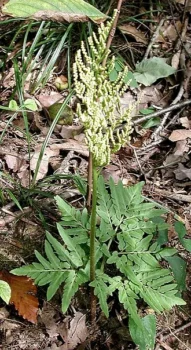
The cutleaf grapefern is like the enigmatic cousin in the fern family. Unlike those showy, feathery ferns you might be familiar with, this perennial native has a more understated charm. It produces distinctive fronds that are deeply cut and dissected (hence the cutleaf name), giving them an almost lacy appearance. But here’s where it gets interesting – it also sends up a separate fertile spike that looks remarkably like a tiny bottle brush, earning it the grapefern moniker.

Where You’ll Find This Native Gem

This little fern is a true North American native, calling both Canada and the lower 48 states home. You can find cutleaf grapefern thriving across an impressive range of states and provinces, from the Maritime provinces of Canada down to Florida, and from the Atlantic coast west to states like Texas, Oklahoma, and Kansas.

  • Species observed
  • No observations

It’s particularly well-suited for USDA hardiness zones 3 through 9, making it adaptable to a wide range of climates.

The Garden Reality Check

Now, here’s where we need to have an honest conversation. While cutleaf grapefern is undeniably fascinating, it’s not exactly what you’d call easy to grow. This fern has some pretty specific needs that make it more of a admire in the wild plant than a pop it in your perennial border kind of species.

The cutleaf grapefern relies on complex relationships with soil fungi (mycorrhizae) to survive and thrive. These partnerships are incredibly difficult to replicate in typical garden settings, which means this fern often struggles when transplanted or grown from spores in cultivation.

If You’re Determined to Try

For the adventurous gardener who wants to attempt growing cutleaf grapefern, here’s what you need to know:

  • Location: Choose a spot with partial to full shade
  • Soil: Provide moist but well-draining soil with acidic to neutral pH
  • Patience: This fern grows slowly and may take years to establish
  • Hands-off approach: Once planted, disturb it as little as possible

Where It Fits in Your Landscape

If you do manage to establish cutleaf grapefern, it works beautifully as:

  • Groundcover in naturalized woodland areas
  • Accent plant in shade gardens
  • Part of a native plant community
  • Addition to rain gardens (thanks to its facultative wetland status)

Wildlife and Ecosystem Benefits

While cutleaf grapefern won’t attract pollinators (ferns don’t flower), it does contribute to the overall ecosystem health of native plant communities. It provides habitat structure and contributes to the complex web of relationships that support native wildlife.

The Bottom Line

Cutleaf grapefern is one of those plants that’s better appreciated in its natural habitat than struggled with in the garden. If you encounter it on woodland walks, take a moment to appreciate its unique beauty and important role in native ecosystems. For your garden, consider easier-to-grow native ferns like Christmas fern or lady fern that will give you that woodland feel without the cultivation headaches.

Sometimes the best way to support native plants is simply to protect and appreciate them where they naturally occur – and cutleaf grapefern is definitely one of those special species worth preserving in the wild.

Botrychium dissectum is also known as...

Often we refer to plants by their common names. When shopping for plants the scientific name is the best way to positively identify the plant species you desire. But some plants have more than one name! While it doesn't happen often, nurseries might display one name while you're searching for another. Botrychium dissectum is also known as:

Botrychium dissectum var. obliquum | USDA symbol: BODIO
Botrychium dissectum var. oblongifolium | USDA symbol: BODIO3
Botrychium obliquum ex | USDA symbol: BOOB
Botrychium obliquum ex var. elongatum Gilbert & | USDA symbol: BOOBE
Sceptridium dissectum | USDA symbol: SCDI8

Why do some plants have more than one name? Over time plant species may be renamed for a few reasons:

  1. Botanists in different regions named the same plant without knowing it had already been classified.
  2. A species was reclassified after scientific advances in, for example, DNA analysis.
  3. Slight variations within a species are sometimes mistakenly identified as entirely new species.

Wetland Status

The rule of seasoned gardeners and landscapers is to choose the "right plant for the right place" — matching plants to their ideal growing conditions, so they'll thrive with less care and fewer inputs. But the simplicity of this catchphrase conceals how tricky plant selection can be if you don't have the right information. While tags on nursery plants list watering requirements, there's more to the story.

Knowing a plant's wetland status can simplify the process by revealing the interaction between plants, water, and soil. You might be surprised to learn that popular landscape plants are wetland species! And what may be a wetland plant in one area, in another it might thrive in drier conditions. The table below gives insight into the preferred growing conditions of this plant throughout its geographical distribution.

Region
Preferred Habitat

Atlantic and Gulf Coastal Plain (AL, AR, DC, DE, FL, GA, IL, KY, LA, MD, MS, MO, NC, NJ, OK, PA, SC, TN, TX, VA)

Facultative

Eastern Mountains and Piedmont (AL, AR, DC, DE, GA, IL, IN, KS, KY, MD, MO, NC, NJ, NY, OH, OK, PA, SC, TN, VA, WV)

Facultative

Great Plains (CO, KS, MN, MT, NE, NM, ND, OK, SD, TX, WY)

Facultative

Midwest (IL, IN, IA, KS, KY, MI, MN, MO, NE, ND, OK, OH, SD, WI)

Facultative

Northcentral & Northeast ()

Facultative
Wetland Glossary
Obligate Wetland
Facultative Wetland
Facultative
Facultative Upland
Obligate Upland
Almost always occurs in wetlands
Usually occurs in wetlands but may occur in non-wetlands
Can occur in wetlands and non-wetlands
Usually occurs in non-wetlands but may occur in wetlands
Almost never occurs in wetlands

Classification

Group: Fern
Kingdom: Plantae - Plants
Subkingdom: Tracheobionta - Vascular plants
Division: Pteridophyta - Ferns
Class: Filicopsida
Order: Ophioglossales
Family: Ophioglossaceae Martinov - Adder's-tongue family
Genus: Botrychium Sw. - grapefern

Species: Botrychium dissectum Spreng. - cutleaf grapefern

Plant data source: USDA, NRCS 2025. The PLANTS Database. https://plants.usda.gov,. 2/25/2025. National Plant Data Team, Greensboro, NC USA