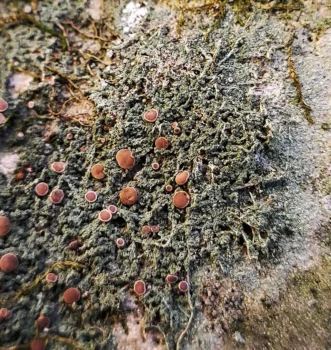
Dotted Lichen: The Tiny Air Quality Monitor in Your Backyard
Have you ever noticed small, crusty patches on tree bark that look almost like someone splattered white paint in tiny dots? You might be looking at dotted lichen (Bacidia rubella), one of nature’s most fascinating partnerships and a surprisingly helpful indicator of your local environment’s health.
What Exactly Is Dotted Lichen?
Before we dive in, let’s clear up what a lichen actually is – because it’s pretty mind-blowing! Dotted lichen isn’t a plant at all. It’s actually two organisms living together in perfect harmony: a fungus and an algae (or sometimes cyanobacteria). The fungus provides structure and protection, while the algae photosynthesizes to create food for both partners. It’s like the ultimate roommate situation that’s been working for millions of years!
Bacidia rubella belongs to a group of lichens known as crustose lichens, which means they form crusty, flattened patches that seem to be painted directly onto surfaces. You’ll also sometimes see this species referred to by its scientific synonym, Bacidia luteola.
Where You’ll Find This Natural Air Monitor
Dotted lichen is native to North America, where it makes its home primarily in eastern and central regions. You’ll typically spot it growing on the bark of hardwood trees in deciduous and mixed forests, though it can occasionally appear in more suburban settings with good air quality.
Your Garden’s Tiny Environmental Detective
Here’s where dotted lichen becomes really interesting for gardeners and nature lovers: it’s incredibly sensitive to air pollution. Think of it as nature’s own air quality monitor! If you find healthy populations of dotted lichen in your area, that’s actually great news – it means your local air is relatively clean.
Lichens like Bacidia rubella absorb nutrients and moisture directly from the air around them, which makes them excellent indicators of environmental health. They’re particularly sensitive to sulfur dioxide and other air pollutants, so their presence (or absence) can tell you a lot about your local ecosystem.
How to Identify Dotted Lichen
Spotting dotted lichen takes a bit of detective work, but once you know what to look for, you’ll start noticing it everywhere:
- Appearance: Small, whitish to pale gray crusty patches on tree bark
- Texture: Thin and closely adhered to the bark surface, almost like it’s been painted on
- Size: Individual patches are typically quite small, often just a few centimeters across
- Location: Most commonly found on the bark of deciduous trees, especially in areas with good air circulation
Benefits to Your Garden Ecosystem
While you can’t exactly plant dotted lichen (and wouldn’t want to try!), having it naturally occur in your garden space is actually beneficial:
- Air quality indicator: Its presence suggests your garden enjoys clean, healthy air
- Biodiversity marker: Healthy lichen populations often correlate with diverse, balanced ecosystems
- Minimal impact: Unlike parasitic organisms, lichens don’t harm their host trees
- Natural beauty: Adds subtle texture and interest to tree bark
Supporting Lichen-Friendly Conditions
You can’t plant lichens, but you can create conditions that support their natural occurrence:
- Avoid using chemical pesticides and fungicides near trees
- Plant native trees that provide good bark surfaces for lichen colonization
- Maintain good air circulation around trees
- Minimize sources of air pollution in your immediate area
The Bottom Line
Dotted lichen might not be something you’ll find at the garden center, but discovering it in your outdoor space is like finding a tiny certificate of environmental approval. These remarkable organisms remind us that some of the most interesting garden residents are the ones that find us naturally – and their presence often signals that we’re doing something right in creating healthy, sustainable outdoor spaces.
Next time you’re out in your garden or local park, take a closer look at the tree bark around you. You might just spot some dotted lichen quietly doing its job as nature’s own environmental monitor!