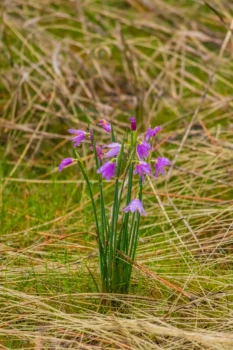
Douglas’ Grasswidow: A Charming Early Spring Native
If you’re looking for a delicate native wildflower that kicks off your garden’s spring show, Douglas’ grasswidow (Olsynium douglasii var. douglasii) might just be the perfect addition to your landscape. This petite perennial brings a splash of early color when most plants are still catching up from winter’s slumber.
What Makes Douglas’ Grasswidow Special?
Don’t let the quirky name fool you – this little beauty has nothing to do with actual grass or unfortunate marital circumstances! Douglas’ grasswidow is a charming member of the iris family that produces small but conspicuous red flowers in early spring. The plant forms neat bunches of fine-textured, gray-green foliage that reaches about one foot in height, making it perfect for adding subtle texture to your garden beds.
You might also see this plant listed under its former names, including Sisyrinchium douglasii, but whatever you call it, this native wildflower is a true Pacific Northwest treasure.
Where Douglas’ Grasswidow Calls Home
This native beauty is right at home across the Pacific Northwest and parts of California. You’ll find Douglas’ grasswidow growing naturally in British Columbia, California, Oregon, and Washington. It’s perfectly adapted to the climate and growing conditions of these regions, which means it’s likely to thrive in your garden if you live in these areas.
- Species observed
- No observations
Why Your Garden Will Love Douglas’ Grasswidow
There are plenty of reasons to consider adding this native charmer to your landscape:
- Early bloomer: Those red flowers appear in early spring when pollinators are desperately seeking their first nectar sources of the year
- Low maintenance: As a native plant, it’s naturally adapted to local conditions and requires minimal fussing once established
- Compact size: At just one foot tall, it won’t overwhelm smaller spaces or compete with larger plants
- Naturalistic appeal: Perfect for creating authentic native plant gardens and naturalized landscapes
- Rock garden star: Its small stature and drought tolerance make it ideal for rock gardens and xeriscaping
Growing Douglas’ Grasswidow Successfully
The good news is that Douglas’ grasswidow isn’t particularly fussy, but like any plant, it has its preferences. Here’s what you need to know to keep it happy:
Soil Requirements
This native prefers well-draining soils and won’t tolerate wet feet. It does best in coarse to medium-textured soils – think sandy loam rather than heavy clay. The plant prefers slightly acidic to neutral soil with a pH between 6.0 and 7.8.
Light and Water Needs
Douglas’ grasswidow prefers full sun but can’t handle much shade, so choose your planting spot accordingly. Once established, it has medium drought tolerance, meaning it can handle some dry spells but appreciates consistent moderate moisture during its growing season.
Climate Considerations
This tough little plant can handle temperatures as low as -23°F and needs at least 120 frost-free days to complete its growing cycle. It’s well-suited to areas receiving 14-20 inches of annual precipitation.
Planting and Propagation Tips
Douglas’ grasswidow can be grown from seed or planted as bulbs. If you’re starting from seed, be patient – seedling vigor is typically low, so germination and establishment can take time. For quicker results, look for bulbs from native plant nurseries, though you might need to special order them since commercial availability is limited.
Plant bulbs in fall for spring blooms, spacing them about 1,700-2,700 per acre if you’re doing a large naturalized planting. For home gardens, plant them about 6-8 inches apart in small drifts for the best visual impact.
Perfect Garden Partners
Douglas’ grasswidow shines in native plant gardens alongside other Pacific Northwest natives. Consider pairing it with native sedges, wild ginger, or other early spring bloomers that share similar growing conditions. Its fine texture and small stature make it an excellent companion for bolder native perennials and shrubs.
A Few Things to Keep in Mind
While Douglas’ grasswidow is generally easy-going, there are a few things to remember:
- It doesn’t resprout after cutting, so avoid heavy foot traffic or mowing during the growing season
- The plant has a moderate lifespan, so you may need to replant every few years
- Seeds are produced in low abundance, so don’t expect it to self-sow aggressively
- It spreads very slowly vegetatively, so don’t worry about it taking over your garden
The Bottom Line
Douglas’ grasswidow is a delightful choice for gardeners who want to support native ecosystems while adding early spring interest to their landscapes. While it may not be the showiest plant in your garden, its quiet charm and ecological benefits make it a worthy addition to native plant gardens, rock gardens, and naturalistic landscapes throughout the Pacific Northwest. Plus, there’s something deeply satisfying about growing a plant that’s perfectly suited to your local environment – it’s gardening in harmony with nature at its finest!