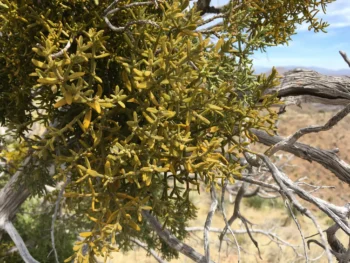
Downy Mistletoe: The Parasitic Native You Won’t Want in Your Garden
If you’ve ever wondered about those mysterious clumps growing in desert trees across the Southwest, you might have spotted downy mistletoe (Phoradendron capitellatum). While this native plant plays an important ecological role in its natural habitat, it’s definitely not something you’d want to invite into your home landscape—and here’s why.
What Exactly Is Downy Mistletoe?
Downy mistletoe is a perennial parasitic shrub that’s quite different from the holiday mistletoe you might be familiar with. This native plant latches onto host trees and draws water and nutrients directly from them, creating those distinctive bushy clumps you might notice high up in tree canopies. Despite being called a shrub, it’s actually a specialized parasite that can’t survive on its own.
Also known by its scientific name Phoradendron capitellatum, this plant typically grows as a multi-stemmed woody parasite that rarely exceeds 4-5 meters in height—though its size depends entirely on its host tree.
Where You’ll Find This Native Plant
Downy mistletoe is native to the southwestern United States, naturally occurring across Arizona, New Mexico, and Texas. It thrives in the desert and semi-desert regions where it finds suitable host trees to call home.
- Species observed
- No observations
Why This Native Isn’t Garden-Friendly
Here’s the thing about downy mistletoe—it’s fascinating from an ecological perspective, but it’s absolutely not suitable for home gardens or landscaping projects. Here’s why:
- It’s a parasite that damages and can eventually kill host trees
- You can’t plant it in soil like traditional plants
- It requires specific host tree species to survive
- It spreads through birds and can infect nearby trees
- It offers minimal aesthetic appeal with tiny, inconspicuous flowers
Growing Conditions and Habitat
In its natural environment, downy mistletoe thrives in USDA hardiness zones 8-10, which correspond to the desert Southwest’s climate. However, growing conditions is a bit of a misnomer since this plant doesn’t grow in soil at all. Instead, it:
- Attaches to branches of host trees through specialized root-like structures
- Prefers desert and semi-arid environments
- Relies entirely on its host for water and nutrients
- Tolerates extreme heat and drought only because its host does
Ecological Role and Wildlife Benefits
While downy mistletoe isn’t garden material, it does serve some ecological purposes in wild settings. Birds sometimes use mistletoe clumps for nesting sites, and the small berries can provide food for wildlife. However, these benefits come at the cost of tree health, making it a complex species from a conservation standpoint.
What This Means for Gardeners
If you’re interested in native Southwest plants, downy mistletoe definitely isn’t the way to go. Instead, consider these fantastic native alternatives that will actually thrive in your garden:
- Desert marigold for bright yellow flowers
- Palo verde trees for stunning spring blooms
- Desert sage for fragrant foliage
- Brittlebush for cheerful daisy-like flowers
The Bottom Line
Downy mistletoe earns its place as a fascinating example of plant adaptation and survival strategy, but it’s strictly a look but don’t plant species. If you spot it in the wild, appreciate it as an interesting part of desert ecosystems—just don’t bring it home! Your trees (and your neighbors’ trees) will thank you for choosing more garden-friendly native plants instead.
Remember, the best native plant gardens celebrate local flora while supporting healthy, thriving landscapes. Downy mistletoe, despite its native status, simply doesn’t fit that bill.