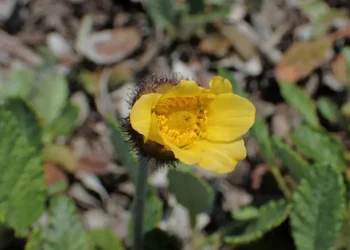
Drummond’s Mountain-Avens: A Hardy Native Ground Cover for Challenging Gardens
If you’re searching for a tough, low-maintenance ground cover that can handle some of nature’s harshest conditions, let me introduce you to Drummond’s mountain-avens (Dryas drummondii). This remarkable little perennial might just be the unsung hero your challenging garden spaces have been waiting for.
What Makes Drummond’s Mountain-Avens Special?
Drummond’s mountain-avens is a true survivor. This native North American perennial forms dense, evergreen mats that rarely grow taller than a foot, making it perfect for situations where you need something that stays low but provides year-round interest. Despite its delicate-sounding name, this plant is anything but fragile.
The plant produces cheerful yellow flowers in late spring that are quite conspicuous against its medium-textured green foliage. While the flowers might not win any size contests, they make up for it with their charm and ability to attract pollinators to your garden. After blooming, the plant develops brown seed heads that, while not particularly showy, add subtle texture to the landscape.
Where Does It Come From?
This mountain-avens is a true North American native, naturally occurring across an impressive range that includes Alaska, multiple Canadian provinces (Alberta, British Columbia, Ontario, Quebec, Saskatchewan, Yukon, and Northwest Territories), and several western U.S. states including Idaho, Montana, Oregon, and Washington, plus Newfoundland. It’s particularly at home in arctic, subarctic, and alpine environments.
- Species observed
- No observations
Perfect Garden Situations
Drummond’s mountain-avens shines in specific garden scenarios:
- Rock gardens: Its prostrate, single-crown growth form makes it ideal for tucking between stones
- Alpine gardens: Native to mountain environments, it feels right at home in high-elevation garden designs
- Naturalistic landscapes: Perfect for creating authentic-looking native plant communities
- Challenging slopes: The slow but steady growth helps with soil stabilization
- Low-water gardens: Once established, it requires minimal irrigation
Growing Conditions and Care
Here’s where Drummond’s mountain-avens really shows its practical side. This plant is remarkably adaptable to difficult conditions:
Soil preferences: It thrives in coarse-textured and medium-textured soils but struggles with heavy clay. The plant prefers slightly acidic to neutral pH levels (6.0-7.5) and has medium tolerance for calcium carbonate.
Sun and shade: While it can tolerate some shade, it performs best in full sun locations.
Water needs: Despite having low drought tolerance, it uses water efficiently and requires medium moisture levels. It’s classified as Facultative Upland, meaning it usually grows in non-wetland areas but can occasionally handle wetter conditions.
Climate requirements: This is where the plant really impresses – it can handle temperatures as low as -43°F and needs at least 90 frost-free days. It’s hardy in USDA zones 2-7, making it suitable for some seriously cold climates.
Planting and Establishment
Getting Drummond’s mountain-avens established requires some patience, as it’s a slow grower with a slow spread rate. Here’s what you need to know:
- Spacing: Plant 1,700-2,700 plants per acre for ground cover applications
- Propagation: Can be grown from seed (908,000 seeds per pound!), bare root plants, or containers
- Timing: Seeds are produced during summer months with medium abundance
- Root depth: Ensure soil allows for at least 12 inches of root penetration
- Fertilizer: Has medium fertility requirements and provides low nitrogen fixation
What to Expect
Set realistic expectations for this plant. Drummond’s mountain-avens is a marathon runner, not a sprinter. It grows slowly but steadily, eventually reaching about one foot in height and width. The plant has a relatively short lifespan but can resprout when damaged, showing impressive resilience.
During the growing season (spring and summer), you’ll enjoy its porous foliage texture that remains evergreen through winter. The plant blooms in late spring, providing nectar for various pollinators including bees and butterflies.
Why Choose Drummond’s Mountain-Avens?
This native plant offers several compelling reasons to include it in your landscape:
- Extremely cold hardy: Few plants can handle such extreme cold
- Native plant benefits: Supports local ecosystems and requires less maintenance once established
- Pollinator support: Provides nectar for native bees and butterflies
- Low maintenance: Once established, requires minimal care
- Evergreen interest: Provides year-round foliage coverage
- Unique texture: Adds interesting prostrate form to garden compositions
Potential Challenges
Be aware of a few limitations:
- Slow establishment means patience is required
- Not suitable for high-traffic areas due to its delicate nature
- Limited drought tolerance means some supplemental watering may be needed
- Commercial availability is limited to contracting only
The Bottom Line
Drummond’s mountain-avens isn’t the flashiest plant you’ll ever grow, but it might be one of the most reliable for challenging conditions. If you’re dealing with cold winters, rocky soils, or slopes that need stabilizing, this native ground cover deserves serious consideration. Just remember that good things come to those who wait – and this little mountain dweller is definitely worth the wait.