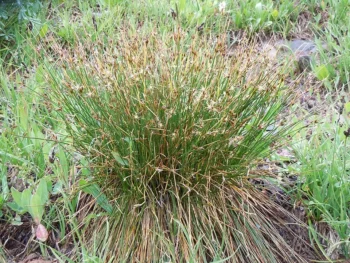
Drummond’s Rush: A Hardy Native Grass for Wetland Gardens
If you’re looking for a resilient, low-maintenance native plant that thrives in moist conditions, Drummond’s rush (Juncus drummondii) might just be your new garden companion. This unassuming perennial rush brings subtle beauty and ecological value to landscapes across western North America, making it a smart choice for gardeners who want to support local ecosystems while creating naturalistic plantings.
What is Drummond’s Rush?
Drummond’s rush is a native perennial rush that belongs to the diverse family of grass-like plants. Don’t let its modest appearance fool you – this hardy plant is a true survivor that has adapted to some of North America’s most challenging mountain and wetland environments. As a bunch-forming grass with an erect growth habit, it creates neat clumps that reach about 1.5 feet tall at maturity.
Where Does It Grow Naturally?
This remarkable rush has an impressive native range spanning across western North America. You’ll find Drummond’s rush growing naturally in Alaska, throughout western Canada (Alberta, British Columbia, Yukon, and Northwest Territories), and across much of the western United States including Arizona, California, Colorado, Idaho, Montana, Nevada, New Mexico, Oregon, Utah, Washington, and Wyoming.
- Species observed
- No observations
Why Consider Drummond’s Rush for Your Garden?
There are several compelling reasons why this native rush deserves a spot in the right garden:
- True native plant: Supporting local ecosystems by choosing plants that naturally belong in your region
- Low maintenance: Once established, it requires minimal care and has low fertility requirements
- Wetland specialist: Perfect for rain gardens, pond edges, and other moisture-loving plantings
- Extremely hardy: Tolerates temperatures down to -38°F, making it suitable for USDA zones 2-7
- Fire tolerant: Bounces back well after fire events
- Long-lived: This perennial will be with you for many years
Garden Design and Landscape Uses
Drummond’s rush shines in specific garden settings where its unique qualities can be appreciated:
- Rain gardens and bioswales: Excellent for managing stormwater runoff
- Pond and stream margins: Creates natural-looking transitions between water and land
- Alpine and rock gardens: Adds texture to high-elevation themed plantings
- Native plant gardens: Perfect companion for other western natives
- Restoration projects: Ideal for wetland and riparian habitat restoration
The plant’s medium-textured, green foliage provides a lovely backdrop for more colorful flowering plants, while its clumping growth form creates structure in naturalistic plantings.
Growing Conditions and Care
Success with Drummond’s rush comes down to understanding its preferences:
Soil: Thrives in coarse to medium-textured soils but struggles in heavy clay. Prefers slightly acidic to neutral pH (5.4-7.0).
Moisture: This is key – Drummond’s rush has low drought tolerance and needs consistent moisture. It’s classified as a facultative wetland plant, meaning it usually grows in wet conditions but can handle some drier periods.
Light: Performs well in full sun to partial shade, showing intermediate shade tolerance.
Climate: Needs at least 70 frost-free days and annual precipitation between 32-55 inches.
Planting and Propagation
Getting Drummond’s rush established in your garden is straightforward:
- Seeds: Can be grown from seed, though germination may be slow
- Bare root plants: Often the easiest way to establish new plantings
- Sprigs: Small divisions can be planted to expand existing colonies
- Availability: Routinely available from native plant nurseries
Plant density should be around 2,700-4,800 plants per acre for restoration projects, but home gardeners can space plants 12-18 inches apart for quicker coverage.
What to Expect
Patience is a virtue with Drummond’s rush. This slow-growing plant takes time to establish, with slow regrowth after cutting and minimal vegetative spread. However, once settled in, it’s remarkably long-lived and low-maintenance.
The summer blooming period produces small, inconspicuous brown flowers that won’t stop traffic but serve their purpose in the plant’s reproductive cycle. Don’t expect showy fall color – this rush keeps things simple with its consistent green appearance.
Wildlife and Ecological Benefits
While Drummond’s rush may not be a pollinator magnet due to its wind-pollinated flowers, it still contributes to healthy ecosystems by providing habitat structure and helping prevent soil erosion in wetland areas. Its presence supports the complex web of wetland ecology that many creatures depend on.
Is Drummond’s Rush Right for Your Garden?
This native rush is an excellent choice if you have consistently moist conditions and want to create naturalistic plantings that support local ecosystems. It’s particularly valuable for gardeners in western regions looking to incorporate authentic native plants into rain gardens, pond edges, or restoration projects.
However, if you’re looking for flashy flowers, rapid growth, or a plant for dry conditions, you might want to consider other options. Drummond’s rush is all about quiet strength and ecological authenticity rather than dramatic garden presence.
For the right gardener in the right location, Drummond’s rush offers the satisfaction of growing a truly native plant that connects your landscape to the broader natural heritage of western North America.