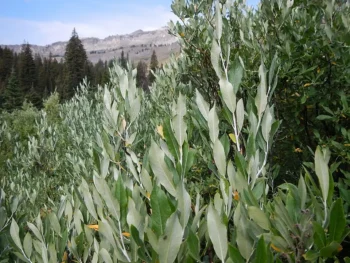
Drummond’s Willow: A Hardy Native Shrub for Wet Spots and Wildlife
If you’ve got a soggy spot in your yard that makes you scratch your head wondering what to plant, meet your new best friend: Drummond’s willow (Salix drummondiana). This unassuming native shrub might not win any flashy flower contests, but it’s the reliable teammate your garden needs for those challenging wet areas where other plants fear to tread.
What Is Drummond’s Willow?
Drummond’s willow is a hardy perennial shrub that’s as North American as apple pie – well, maybe more so since it’s actually native here! This multi-stemmed woody plant typically reaches about 12 feet tall and spreads into a nice, dense form. Don’t expect it to stay put in a neat little clump though; this willow has a rapid growth rate and means business when it comes to filling space.
Like many willows, Drummond’s willow sports that classic green foliage with a medium texture that provides good coverage during growing season. In early spring, you’ll spot small yellow flowers that might not stop traffic but certainly get the pollinators buzzing with excitement.
Where Does It Call Home?
This adaptable native has quite the impressive range across western North America. You’ll find Drummond’s willow growing naturally from the northern reaches of Canada (Alberta, British Columbia, Saskatchewan, Yukon, and Northwest Territories) down through the western United States in California, Colorado, Idaho, Montana, Nevada, New Mexico, Oregon, Utah, Washington, and Wyoming.
- Species observed
- No observations
Why Your Garden Might Love This Willow
Here’s where Drummond’s willow really shines – it’s practically designed for problem-solving in the landscape:
- Wet soil champion: Classified as Facultative Wetland across its range, this shrub actually thrives in those persistently moist areas where other plants struggle
- Erosion control hero: Those roots work overtime to stabilize soil, making it perfect for slopes or areas prone to washout
- Early pollinator support: Those early spring yellow blooms provide crucial nectar when few other plants are flowering
- Low-maintenance attitude: Once established, it’s pretty much a plant it and forget it situation
- Cold hardy: Can handle temperatures down to -28°F, so northern gardeners rejoice!
Perfect Spots for Planting
Drummond’s willow isn’t meant for formal gardens or tidy foundation plantings. Instead, think of it as your go-to plant for:
- Rain gardens and bioswales
- Riparian restoration projects
- Naturalized areas and wildlife gardens
- Erosion-prone slopes near water features
- Wetland edges and seasonal wet areas
- Screening for informal landscapes
Growing Conditions That Make It Happy
The beauty of Drummond’s willow lies in its adaptability, but it does have some preferences:
- Soil: Accepts coarse, medium, or fine-textured soils (it’s not picky!)
- Moisture: High water needs – this is not your drought-tolerant option
- Sun exposure: Intermediate shade tolerance, but generally prefers full sun to partial shade
- pH range: Tolerates slightly acidic to neutral soils (5.2-7.4)
- Climate: Needs at least 110 frost-free days and 16-40 inches annual precipitation
Planting and Care Tips
Getting Drummond’s willow established is refreshingly straightforward:
- Propagation options: You can start from seed, cuttings, bare root plants, or containers – it’s quite accommodating
- Planting density: Space plants for 1,200-2,724 per acre depending on your goals
- Initial care: Keep consistently moist during establishment (which shouldn’t be hard given its preferred wet conditions)
- Ongoing maintenance: Very minimal – it can handle coppicing if you need to cut it back
- Fertilization: Medium fertility requirements, so average garden soil should suffice
Things to Keep in Mind
Before you rush out to plant Drummond’s willow everywhere, consider these characteristics:
- It’s not particularly showy – think function over form
- Requires consistent moisture, so not suitable for xeriscape gardens
- Can grow quite large (up to 12 feet), so give it room
- Drops its leaves in winter (no evergreen screening here)
- Fast growth means it might outpace your expectations
The Bottom Line
Drummond’s willow might not be the star of your garden show, but it’s definitely the dependable supporting actor that makes everything else possible. If you’re dealing with wet soils, need erosion control, want to support early pollinators, or are working on habitat restoration, this native shrub deserves serious consideration.
It’s particularly valuable for gardeners who want to work with their land’s natural conditions rather than fighting against them. Sometimes the best plants are the ones that solve problems while asking for very little in return – and Drummond’s willow fits that bill perfectly.