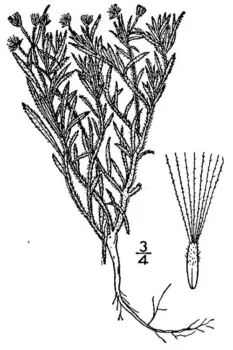
Dwarf Horseweed: A Humble Native with Mixed Reviews
Meet dwarf horseweed (Conyza ramosissima), a small annual plant that’s probably more familiar to you than you might think. This unassuming member of the aster family has been quietly making itself at home across much of North America, though gardeners have decidedly mixed feelings about its presence.
What Exactly Is Dwarf Horseweed?
Dwarf horseweed is an annual forb – that’s garden-speak for a soft-stemmed herbaceous plant that completes its entire life cycle in one growing season. You might also encounter it under its former scientific names, Erigeron divaricatus or Leptilon divaricatum, if you’re digging through older botanical references.
This plant produces small, rather unremarkable white to pale pink flowers that cluster at the tips of branching stems. True to its dwarf moniker, it typically stays relatively compact, though it can spread through prolific self-seeding.
Where Does It Call Home?
Dwarf horseweed is a true American native, originating in the central and eastern United States. Today, you can find it growing wild across a impressive range of states including Alabama, Arkansas, Illinois, Indiana, Iowa, Kansas, Kentucky, Louisiana, Minnesota, Mississippi, Missouri, Nebraska, New Mexico, North Dakota, Ohio, Oklahoma, Pennsylvania, South Dakota, Tennessee, Texas, and Wisconsin. It’s also established itself in Ontario, Canada, where it’s considered non-native but naturalized.
- Species observed
- No observations
Should You Invite It Into Your Garden?
Here’s where things get interesting – and a bit complicated. While dwarf horseweed is technically a native plant across much of its range, it’s rarely invited into gardens on purpose. Most gardeners encounter it as a volunteer that shows up uninvited in disturbed soil, along pathways, or in less-maintained areas of the landscape.
The Case Against Growing It
- Limited ornamental appeal – the flowers are quite small and unremarkable
- Tends to look weedy rather than intentionally cultivated
- Self-seeds aggressively and can pop up where you don’t want it
- Better native alternatives exist for most garden purposes
The Case for Tolerance
- It’s a true native species supporting local ecosystems
- Requires zero maintenance once established
- Grows in poor soils where other plants struggle
- Small flowers do provide some nectar for tiny pollinators
Growing Conditions and Care
If you’re determined to give dwarf horseweed a chance (or if it’s already made itself at home), here’s what it prefers:
- Sunlight: Full sun to partial shade
- Soil: Tolerates poor, disturbed soils; actually thrives in less-than-ideal conditions
- Water: Drought tolerant once established
- Maintenance: Essentially none required
As an annual, dwarf horseweed will complete its life cycle in one growing season, but don’t worry about replanting – it’s exceptionally good at self-seeding. In fact, you’ll likely spend more time removing unwanted seedlings than encouraging growth.
Better Native Alternatives
If you’re looking to support native plant communities but want something with more visual impact, consider these alternatives:
- Wild bergamot (Monarda fistulosa): Showy purple flowers beloved by bees and butterflies
- Purple coneflower (Echinacea purpurea): Bold blooms that attract pollinators and birds
- Black-eyed Susan (Rudbeckia species): Cheerful yellow flowers with excellent wildlife value
- New England aster (Symphyotrichum novae-angliae): Fall-blooming native with much more ornamental appeal
The Bottom Line
Dwarf horseweed occupies an interesting niche in the native plant world – it’s authentically native and ecologically valuable, but it’s not going to win any beauty contests. If it appears naturally in your landscape, there’s no harm in letting it be, especially in areas where you’re aiming for a more naturalized look. However, if you’re actively planning a native plant garden, your efforts and space are probably better invested in more charismatic native species that offer both ecological benefits and visual appeal.
Sometimes the most honest thing we can say about a native plant is that while we respect its place in the ecosystem, we don’t necessarily need to roll out the red carpet for it in our carefully curated garden spaces. Dwarf horseweed falls squarely into this category – a humble native that’s perfectly fine where it chooses to grow, but probably not your first choice for intentional planting.