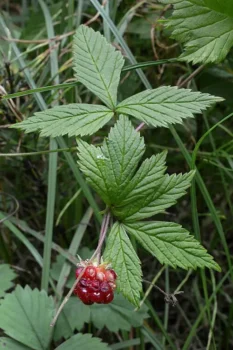
Dwarf Red Blackberry: A Native Groundcover Gem for Woodland Gardens
If you’re searching for a charming native groundcover that offers both beauty and ecological value, meet the dwarf red blackberry (Rubus pubescens). This delightful little perennial might just be the perfect addition to your shade garden – and yes, it really does produce tiny edible berries!
What Makes Dwarf Red Blackberry Special?
Despite its name, dwarf red blackberry isn’t quite what you’d expect from a typical blackberry plant. This herbaceous perennial grows as a low, spreading groundcover rather than the tall, thorny canes you might picture. It’s classified as a forb herb, meaning it lacks significant woody tissue and keeps its growing points at or below ground level – perfect for creating a soft carpet in your garden.
In late spring, small white flowers appear, followed by clusters of bright red berries that are technically edible (though quite tart and seedy). The real show-stopper, however, is the foliage, which transforms from green to beautiful reddish tones in fall.
Where Does It Call Home?
Dwarf red blackberry is a true North American native with an impressive range. It naturally occurs across Alaska, most of Canada, and extends south into the northern United States, with populations found in states from Maine to Washington and south into the mountainous regions of Colorado and Oregon. You’ll find it growing in Alberta, British Columbia, Alaska, Manitoba, New Brunswick, Nova Scotia, Ontario, Colorado, Prince Edward Island, Connecticut, Quebec, Saskatchewan, Yukon, Northwest Territories, Idaho, Illinois, Indiana, Iowa, Maine, Massachusetts, Michigan, Minnesota, Montana, Nebraska, New Hampshire, New Jersey, New York, North Dakota, Ohio, Oregon, Pennsylvania, Rhode Island, South Dakota, Vermont, Washington, West Virginia, Wisconsin, Wyoming, Labrador, and Newfoundland.
- Species observed
- No observations
Why Your Garden (and Local Wildlife) Will Love It
There are several compelling reasons to consider dwarf red blackberry for your landscape:
- Native Plant Power: As a native species, it supports local ecosystems and requires less maintenance once established
- Pollinator Friendly: The spring flowers attract native bees, flies, and other small pollinators
- Wetland Tolerance: This adaptable plant can handle both moist and occasionally wet conditions, making it excellent for rain gardens or naturally damp areas
- Low Maintenance: Once established, it spreads naturally via runners to form attractive colonies
- Year-Round Interest: Spring flowers, summer berries, and fall color provide multi-season appeal
Perfect Garden Settings
Dwarf red blackberry shines in several garden scenarios:
- Woodland and shade gardens as understory groundcover
- Native plant gardens and naturalized landscapes
- Rain gardens and areas with consistent moisture
- Erosion control on gentle slopes
- Border edges where you want soft, spreading texture
Growing Conditions and Care
Hardiness: Thrives in USDA zones 2-7, making it an excellent choice for northern gardeners
Light Requirements: Prefers partial shade to full shade – think dappled sunlight under trees
Soil Needs: Loves consistently moist to wet soils with good organic content. It can handle various wetland conditions, from facultative wetland status in most regions to facultative (equally at home in wet or dry sites) in some western areas.
pH Preference: Acidic to neutral soils work best
Planting and Care Tips
Getting dwarf red blackberry established in your garden is refreshingly straightforward:
- Timing: Plant in spring after the last frost for best establishment
- Spacing: Allow 12-18 inches between plants – they’ll fill in naturally
- Watering: Maintain consistent moisture, especially during the first growing season
- Mulching: Apply organic mulch to retain moisture and suppress weeds
- Spreading: Expect gradual expansion via underground runners – this is normal and desirable for groundcover use
- Maintenance: Minimal pruning needed; simply remove any dead or damaged foliage in spring
A Few Things to Consider
While dwarf red blackberry is generally well-behaved, keep in mind that it does spread naturally. This makes it excellent for areas where you want gradual coverage, but you might want to think twice about planting it right next to more formal garden beds where its spreading nature might not be welcome.
The berries, while edible, are quite small and tart – they’re more valuable for wildlife than for your breakfast table!
The Bottom Line
Dwarf red blackberry offers native plant enthusiasts a wonderful opportunity to add a useful, attractive groundcover to their shade gardens. Its combination of spring flowers, interesting berries, fall color, and ecological benefits makes it a smart choice for anyone looking to create habitat while enjoying a low-maintenance, beautiful garden feature. If you have a partially shaded spot with consistent moisture, this charming native groundcover might be exactly what your landscape has been waiting for.