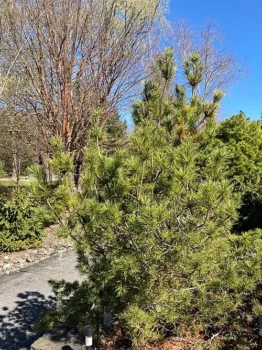
Eastern White Pine: A Majestic Native Evergreen for Larger Landscapes
If you’re dreaming of a stately evergreen that whispers established elegance while supporting local wildlife, the Eastern White Pine (Pinus strobus) might just be your perfect match. This native North American beauty has been gracing our landscapes for centuries, and there’s good reason why it remains a beloved choice for gardeners with room to let it shine.
Meet the Eastern White Pine
The Eastern White Pine is a perennial evergreen tree that’s as American as apple pie. This magnificent specimen is native to Canada, the lower 48 states, and even St. Pierre and Miquelon, making it a true North American treasure. You’ll find it growing naturally across an impressive range of states and provinces, from Alabama and Arkansas in the south, all the way up to Newfoundland, and west to Manitoba, Iowa, and Minnesota.
- Species observed
- No observations
What sets this pine apart from its cousins? Those gorgeous soft, blue-green needles arranged in bundles of five, and a growth habit that starts pyramidal in youth before developing into an irregularly crowned giant with character and charm.
Size Matters: What to Expect
Here’s where we need to have an honest conversation about space. The Eastern White Pine is not a shrinking violet. This rapid grower can reach 40 feet in just 20 years and eventually towers up to 150 feet at maturity. With its single-stemmed trunk and erect growth habit, it commands attention and requires the room to do so properly.
If you’re working with a small suburban lot, this might not be your tree. But if you have a larger property, park-like setting, or want to create a dramatic focal point, few trees can match its presence.
Why Choose Eastern White Pine?
Beyond its impressive stature, this native evergreen offers several compelling benefits:
- Native credentials: Supporting local ecosystems and wildlife
- Year-round interest: Dense foliage provides privacy and windbreak protection
- Rapid growth: Relatively quick establishment compared to other large trees
- Fine texture: Soft needles create an elegant appearance
- Wildlife habitat: Provides shelter and nesting sites for birds and small mammals
Perfect Growing Conditions
Eastern White Pine is surprisingly adaptable, but like any plant, it has preferences. Here’s what makes it happiest:
- Soil: Medium-textured, well-draining soils (avoid heavy clay or very sandy conditions)
- pH: Slightly acidic conditions between 4.0-6.5
- Moisture: Medium moisture needs – not drought tolerant but doesn’t like waterlogged conditions
- Light: Full sun to partial shade (intermediate shade tolerance)
- Climate: Hardy in USDA zones 3-8, tolerating temperatures as low as -33°F
The wetland status tells us this tree prefers upland sites but can occasionally tolerate some moisture – just don’t plant it in a swamp!
Landscape Uses and Design Ideas
Eastern White Pine shines in several landscape roles:
- Specimen tree: Plant solo as a dramatic focal point
- Windbreak: Create rows for wind protection and privacy
- Woodland gardens: Perfect for naturalized settings
- Large-scale screening: Block unwanted views while creating habitat
- Park and estate settings: Ideal for spacious, formal landscapes
Planting and Care Tips
Getting your Eastern White Pine off to a strong start requires attention to a few key details:
Planting: This tree is commonly available and can be planted as bare root, container, or even grown from cuttings. Seeds require cold stratification and need at least 90 frost-free days to establish properly.
Spacing: Plan for 430-1200 trees per acre if you’re doing mass plantings, but for individual specimens, give them plenty of room – think 30+ feet from structures and other large trees.
Care considerations:
- Low fertility requirements (don’t over-fertilize)
- No drought tolerance – provide supplemental water during dry spells
- Poor tolerance for air pollution and salt
- Minimal pruning needed due to natural growth form
- Watch for white pine weevil in young trees
Wildlife and Ecological Benefits
While Eastern White Pine flowers aren’t showy (small red blooms in late spring) and it’s wind-pollinated rather than insect-pollinated, it provides significant ecological value. The dense evergreen canopy offers year-round shelter for birds, and the seeds feed various wildlife species. The brown cones are quite conspicuous and add winter interest to the landscape.
Is Eastern White Pine Right for You?
This majestic native is perfect for gardeners who:
- Have large properties or spacious landscapes
- Want to support native ecosystems
- Need effective windbreaks or privacy screening
- Appreciate the beauty of large evergreen specimens
- Can provide consistent moisture and avoid polluted areas
However, consider alternatives if you have limited space, deal with frequent droughts, high salt exposure, or want a low-maintenance tree that can handle neglect.
The Eastern White Pine represents everything wonderful about native gardening – it’s beautiful, ecologically valuable, and perfectly adapted to our North American climate. Just make sure you have the space to let this gentle giant reach its full potential!