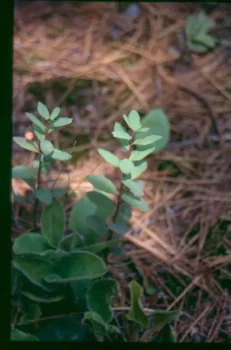
False Toadflax: A Fascinating Native Ground Cover for Northern Gardens
If you’re drawn to unusual native plants that tell a story, false toadflax might just capture your imagination. This unassuming little perennial has some quirky secrets that make it both fascinating and challenging for home gardeners. Let’s dive into what makes Geocaulon lividum such an interesting addition to specialized native plant collections.
What is False Toadflax?
False toadflax (Geocaulon lividum) is a low-growing perennial forb that’s native across a remarkably wide swath of northern North America. You might also see it listed under its old scientific name, Comandra lividum. As a herbaceous plant without woody stems, it stays close to the ground and produces small, rather inconspicuous greenish-white flowers.
Don’t expect this plant to be the showstopper in your garden border – its beauty lies in subtlety and its role in natural ecosystems rather than flashy blooms.
Where Does False Toadflax Grow Naturally?
This hardy little plant has an impressive natural range, stretching from Alaska all the way to Newfoundland and down into the northern United States. You’ll find it growing wild in:
- All Canadian provinces and territories
- Alaska
- Northern states including Maine, New Hampshire, Vermont, New York, Michigan, Wisconsin, Minnesota, Montana, Idaho, and Washington
Its widespread distribution across such diverse northern regions speaks to its adaptability to cold climates and various soil conditions.
- Species observed
- No observations
Should You Plant False Toadflax in Your Garden?
Here’s where things get interesting – and a bit complicated. False toadflax has a secret: it’s what botanists call a root parasite. This means it connects to the roots of other plants to supplement its nutrition, which makes it quite challenging to grow in typical garden settings.
Reasons you might want to try it:
- It’s a true native species that supports local ecosystems
- Extremely cold hardy (suitable for USDA zones 1-6)
- Low-growing ground cover for naturalized areas
- Interesting conversation piece for native plant enthusiasts
- Contributes to biodiversity in restoration projects
Reasons you might want to skip it:
- Very difficult to establish and maintain in cultivation
- Minimal ornamental appeal compared to other native options
- Parasitic nature makes it unpredictable in garden settings
- Limited availability from nurseries
Growing Conditions and Care
If you’re determined to try growing false toadflax, here’s what it prefers in the wild:
Soil: Typically grows in acidic soils, often in sandy or rocky conditions
Light: Adaptable to both partial shade and full sun
Moisture: Its wetland status varies by region – it can handle both wetland and upland conditions, making it quite flexible about moisture levels
Climate: Thrives in cool, northern climates (zones 1-6)
The Challenge of Cultivation
Let’s be honest – false toadflax isn’t your typical garden center find, and there’s a good reason for that. Its parasitic lifestyle means it needs host plants to thrive, and replicating these complex underground relationships in a home garden is extremely difficult.
Most gardeners interested in supporting northern native ecosystems would be better served by choosing other native ground covers that are easier to establish and maintain.
Wildlife and Ecological Benefits
While false toadflax may not be the most garden-friendly plant, it does play a role in its native ecosystems. Its small flowers may provide nectar for tiny insects, and the plant itself contributes to the complex web of relationships that support northern forest and grassland communities.
The Bottom Line
False toadflax is more of a botanical curiosity than a practical garden plant for most home gardeners. If you’re working on a large-scale restoration project in its native range, it might be worth including. For typical home landscapes, consider other native ground covers that will give you more reliable results and greater visual impact.
If you’re fascinated by this plant’s unique lifestyle, you might be better off seeking it out on nature walks in its native habitat, where you can appreciate it as part of the complex natural communities it calls home.