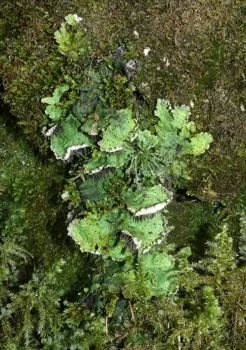
Felt Lichen: The Fascinating Peltigera leucophlebia in Your Garden
Have you ever noticed crusty, leaf-like growths spreading across rocks, soil, or tree bark in your garden and wondered what they were? You might be looking at felt lichen, scientifically known as Peltigera leucophlebia, one of nature’s most fascinating and misunderstood organisms.
What Exactly Is Felt Lichen?
Here’s where things get interesting – felt lichen isn’t actually a plant at all! It’s what scientists call a composite organism, made up of a fungus and an algae living together in perfect harmony. Think of it as nature’s ultimate roommate situation, where both partners benefit from the arrangement. The fungus provides structure and protection, while the algae produces food through photosynthesis.
Peltigera leucophlebia belongs to a group of lichens that are native to North America, making them a natural part of our continent’s ecological tapestry.
Where You’ll Find This Natural Wonder
While specific distribution data for Peltigera leucophlebia is limited in current research, members of the Peltigera family are typically found across various North American habitats. These resilient organisms have adapted to life in diverse environments, from forest floors to rocky outcrops.
Is Felt Lichen Welcome in Your Garden?
The short answer? Absolutely! Finding felt lichen in your garden is actually a good sign. Here’s why you should celebrate these quiet garden inhabitants:
- They indicate good air quality – lichens are sensitive to pollution
- They help prevent soil erosion with their mat-like growth
- They add interesting texture and natural character to garden spaces
- They require zero maintenance from you
- They’re completely harmless to other plants
Spotting Felt Lichen in the Wild
Identifying felt lichen can be tricky since many lichens look similar to the untrained eye. Look for these characteristics:
- Leaf-like or crusty appearance that lies flat against surfaces
- Gray-green to brownish coloration
- Texture that feels somewhat like felt (hence the name!)
- Growth on soil, rocks, or tree bark
- Presence in areas with clean air
The Hands-Off Approach to Lichen Care
Here’s the beautiful thing about lichens – they don’t need your help! In fact, the best thing you can do for felt lichen is to leave it alone. These remarkable organisms:
- Get their nutrients from the air and rain
- Grow incredibly slowly (we’re talking millimeters per year)
- Can survive extreme conditions that would kill most plants
- Don’t compete with your garden plants for resources
Creating a Lichen-Friendly Environment
While you can’t really grow lichens in the traditional sense, you can make your garden more welcoming to them:
- Avoid using chemical pesticides and fertilizers
- Leave some undisturbed areas in your garden
- Don’t remove them from rocks or trees where they’re already established
- Maintain good air quality around your property
Why Felt Lichen Matters
Beyond their quiet beauty, lichens like Peltigera leucophlebia serve as important environmental indicators. Their presence tells us that the air is clean and the ecosystem is healthy. They’re also part of the complex web of life that supports biodiversity in our gardens and natural spaces.
So the next time you spot what looks like felt lichen in your garden, take a moment to appreciate these ancient partnerships. They’ve been perfecting the art of cooperation for millions of years, quietly doing their part to keep our world green and healthy.