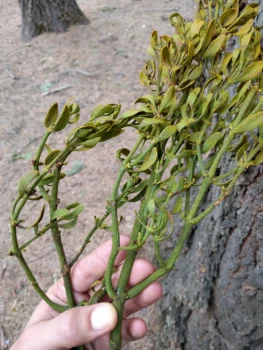
Fir Mistletoe: The Fascinating Parasitic Plant You Can’t (And Shouldn’t) Grow
If you’ve ever wondered about those mysterious clumps growing on trees in the Southwest, you might be looking at fir mistletoe (Phoradendron pauciflorum). This native perennial shrub has a lifestyle that’s quite different from your typical garden plant – and for good reason, it’s not actually something you can or should try to cultivate in your backyard.
What Makes Fir Mistletoe Special
Fir mistletoe is what botanists call an obligate parasite, which means it literally can’t survive without attaching itself to a host tree. Unlike the holiday mistletoe you might be familiar with, this southwestern native has adapted to live exclusively on coniferous trees, particularly firs. It forms distinctive rounded, bushy clumps that can be spotted from quite a distance.
This perennial shrub typically grows as a multi-stemmed woody plant, usually staying under 13-16 feet in height, though its growth is entirely dependent on its host tree’s health and size.
Where You’ll Find Fir Mistletoe
As a native species to the lower 48 states, fir mistletoe has a relatively limited natural range, primarily found in Arizona and California. It thrives in the mountainous regions where its preferred host trees grow naturally.
- Species observed
- No observations
Why You Can’t Grow It in Your Garden
Here’s the fascinating (and slightly disappointing for curious gardeners) truth: fir mistletoe cannot be cultivated in traditional gardens. As an obligate parasite, it requires a living host tree to survive. Even if you have suitable conifers in your landscape, attempting to introduce mistletoe would be:
- Potentially harmful to your trees
- Extremely difficult to establish successfully
- Unpredictable in terms of spread and impact
Its Role in Nature
While fir mistletoe might seem like a tree troublemaker, it actually plays important ecological roles. These parasitic plants can provide nectar sources for various insects and pollinators. In its native habitat, it’s part of a complex ecosystem where it has co-evolved with its host trees over thousands of years.
However, it’s worth noting that this species has a somewhat unclear conservation status (listed as S5T3?), which suggests there may be some questions about its population stability in certain areas.
What This Means for Your Native Garden
If you’re interested in supporting native ecosystems in Arizona or California, focus on planting the trees that serve as natural hosts for species like fir mistletoe rather than trying to cultivate the mistletoe itself. Native conifers and other trees that support complex ecological relationships are much better choices for home landscapes.
Consider native alternatives like:
- Native oak species
- Indigenous pine varieties
- Native shrubs that provide similar wildlife benefits without parasitic behavior
The Bottom Line
Fir mistletoe is definitely a plant to admire from afar rather than invite into your garden. Its specialized lifestyle makes it unsuitable for cultivation, and its parasitic nature means it could potentially harm trees in your landscape. Instead, appreciate this unique native species in its natural habitat and focus your gardening efforts on other native plants that will thrive in traditional garden settings while still supporting local ecosystems.
Remember, not every native plant is meant for the home garden – and that’s perfectly okay! Part of being a responsible native plant gardener is understanding which species belong in wild spaces and which ones can successfully transition to cultivated landscapes.