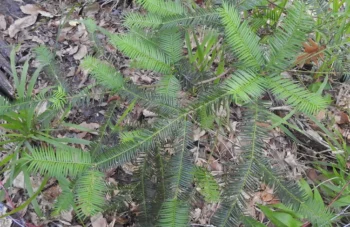
Florida Nutmeg: A Living Fossil That Needs Your Help
Meet the Florida nutmeg (Torreya taxifolia), one of North America’s rarest trees and a true botanical treasure that’s fighting for survival. This ancient conifer, also known by its synonym Tumion taxifolium, represents a living link to prehistoric forests and desperately needs conservation-minded gardeners to help secure its future.
A Tree on the Brink
The Florida nutmeg carries a sobering distinction: it’s critically imperiled with a Global Conservation Status of S1, meaning fewer than 1,000 individuals likely remain in the wild. In Florida, it’s officially listed as Endangered. This isn’t just another rare plant – it’s a species teetering on the edge of extinction that once thrived in the southeastern United States.
Where It Calls Home
Originally native to the lower 48 states, the Florida nutmeg’s current wild range has shrunk dramatically to small populations along the Apalachicola River in the Florida Panhandle and adjacent areas of southwestern Georgia. What was once a more widespread species has been reduced to scattered remnant populations clinging to survival in steep ravines and bluffs.
- Species observed
- No observations
Why This Tree Deserves Your Attention
The Florida nutmeg is a perennial evergreen tree that can reach 40 feet at maturity, though it grows at a moderate pace, typically reaching about 20 feet after 20 years. Its single-stemmed growth form creates an erect, pyramidal shape when young, developing character as it matures. The fine-textured, dark green foliage remains beautiful year-round, and the tree produces conspicuous blue fruits that add seasonal interest.
What makes this species particularly special is its ancient lineage – Torreya represents one of the oldest conifer genera, sometimes called a living fossil. Growing one in your landscape means participating in conservation efforts while enjoying a truly unique specimen tree.
Garden Role and Landscape Use
Florida nutmeg works beautifully as:
- A specimen tree in woodland gardens
- Part of native plant conservation collections
- A unique shade tree for appropriate climates
- An educational focal point in botanical or heritage gardens
This tree thrives in partial to full shade, making it perfect for woodland settings or as an understory specimen. It’s particularly well-suited for botanical gardens, arboretums, or private collections focused on rare and endangered species.
Growing Conditions and Care
Successfully growing Florida nutmeg requires understanding its specific needs:
Soil and pH: Prefers medium-textured, well-draining soils with a pH between 5.0 and 7.0. It has medium fertility requirements and doesn’t tolerate waterlogged conditions.
Light and Temperature: Shade tolerant (actually prefers it!) and hardy in USDA zones 8-9. It needs at least 270 frost-free days annually and can tolerate temperatures as low as 12°F.
Water and Humidity: Has low drought tolerance and requires consistent moisture. Annual precipitation should range between 30-60 inches, with medium moisture use throughout the growing season.
Special Considerations: This tree has moderate fire tolerance, no frost tolerance, and cannot handle salt exposure. Its deep root system (minimum 40 inches) helps it access consistent moisture.
Planting and Propagation
Growing Florida nutmeg from seed is possible but challenging. Seeds are produced in low abundance from summer through fall, with about 225 seeds per pound. Seedling vigor is low, and germination can be tricky without proper stratification.
The tree can be propagated by:
- Seed (most common method)
- Bare root transplants
- Container-grown specimens
Commercial availability is extremely limited, typically available only through specialized native plant nurseries or conservation programs on a contract basis.
Important Conservation Note
If you’re considering adding Florida nutmeg to your landscape, please ensure you source plants or seeds responsibly. Never collect from wild populations. Work only with reputable native plant nurseries or conservation organizations that can verify their stock comes from ethically propagated sources.
Your garden could become part of this species’ insurance policy against extinction – but only when done right.
Wildlife and Pollinator Benefits
As a gymnosperm, Florida nutmeg is wind-pollinated rather than insect-pollinated, so it doesn’t provide nectar for bees and butterflies. However, its seeds may provide food for wildlife, and the tree offers shelter and nesting sites for birds and small mammals.
Is Florida Nutmeg Right for Your Garden?
This remarkable tree isn’t for every gardener or every garden. It requires specific growing conditions, patience (due to slow growth), and a commitment to conservation. However, for those in suitable climates (zones 8-9) who can provide the right conditions and source plants ethically, growing Florida nutmeg offers the profound satisfaction of helping preserve one of North America’s rarest trees.
Consider Florida nutmeg if you:
- Live in zones 8-9 with high humidity
- Have a shaded woodland garden or partial shade area
- Can provide consistent moisture and well-draining soil
- Want to participate in species conservation
- Appreciate rare and unique specimen trees
By choosing to grow this critically endangered species, you’re not just adding a beautiful tree to your landscape – you’re becoming a guardian of botanical heritage and helping ensure that future generations can experience the wonder of the Florida nutmeg.