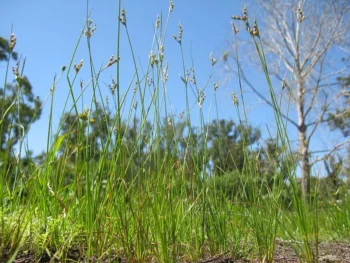
Forked Rush: A Humble Native Grass for Wet Spots in Your Garden
Meet the forked rush (Juncus dichotomus), a plant that might not win any beauty contests but certainly deserves a spot in the conversation about native gardening. This unassuming perennial grass-like plant is one of those quiet workhorses that keeps ecosystems humming along without much fanfare—kind of like the friend who always remembers to bring snacks to the party.
What Exactly Is Forked Rush?
Forked rush is a native perennial that belongs to the rush family, making it a grass-like plant rather than a true grass. Don’t let the grass-like description fool you into thinking it’s boring—this little green wonder has been quietly doing its job across North America for ages. It typically reaches about 2.9 feet tall and grows in distinctive bunches with an upright, erect form.
The plant gets its forked common name from its branching flower clusters, though you might need to look closely to appreciate this detail since the flowers are small and green. Speaking of names, you might also encounter this plant listed under several scientific synonyms, including Juncus platyphyllus and various varieties of Juncus tenuis, but Juncus dichotomus is the name that stuck.
Where Does Forked Rush Call Home?
This native beauty has quite the impressive range across the United States and Puerto Rico. You’ll find forked rush growing naturally in 30 states, stretching from Maine down to Florida, west to Colorado and New Mexico, and even in Puerto Rico. It’s particularly common throughout the Eastern United States, the Great Plains, and parts of the Southwest.
- Species observed
- No observations
Growing Conditions: What Makes Forked Rush Happy
Here’s where forked rush gets interesting for gardeners dealing with challenging spots. This plant is what botanists call facultative wetland, which basically means it loves wet feet but can tolerate drier conditions when necessary. Think of it as the plant equivalent of someone who prefers rainy days but won’t complain about sunshine.
Forked rush thrives in:
- Acidic soils with a pH between 4.5 and 6.5
- Areas with consistent moisture (though it has low drought tolerance)
- Full sun to partial shade conditions
- USDA hardiness zones 3-9
- Coarse to medium-textured soils
The plant is remarkably adaptable to flooding and can handle high levels of anaerobic conditions, making it perfect for those soggy spots where other plants throw in the towel.
Why You Might Want Forked Rush in Your Garden
Let’s be honest—forked rush isn’t going to stop traffic with its stunning blooms. The flowers are small, green, and appear in early summer, followed by brown seeds from summer through fall. But here’s why you might want to give this humble plant a chance:
- Problem-solver extraordinaire: Got a wet, boggy area where nothing else will grow? Forked rush to the rescue!
- Low maintenance: Once established, it requires minimal care and has moderate longevity
- Erosion control: Those bunch-forming roots help stabilize soil
- Native wildlife support: While specific wildlife benefits aren’t well-documented, native rushes typically support various insects and provide nesting material for birds
- Fire tolerance: Surprisingly resilient to fire, making it suitable for fire-prone regions
Perfect Garden Scenarios for Forked Rush
Forked rush shines in specific garden situations:
- Rain gardens and bioswales
- Pond and stream margins
- Native plant gardens focusing on local ecosystems
- Naturalized areas and meadows
- Restoration projects
- Areas with seasonal flooding
Planting and Care Tips
Growing forked rush successfully is refreshingly straightforward:
Starting from seed: Seeds can be sown directly in spring, though they have a slow spread rate and low abundance. Patience is key—this isn’t a plant for instant gratification seekers.
Other propagation methods: The plant can be propagated by bare root divisions or sprigs, which might give you faster results than seeds.
Spacing: Plan for 2,700 to 4,800 plants per acre if you’re doing large-scale plantings, though most home gardeners will want just a few clumps.
Maintenance: Once established, forked rush is remarkably low-maintenance. It has a moderate growth rate and doesn’t require fertilization (it actually prefers low fertility conditions). The foliage may turn reddish and becomes quite dense in summer.
The Honest Assessment
Forked rush isn’t for everyone, and that’s okay. If you’re looking for showy flowers or dramatic foliage, you might want to look elsewhere. This plant is more about function than form—it’s the sensible shoes of the plant world.
However, if you have challenging wet areas, appreciate native plants, or want to support local ecosystems, forked rush could be exactly what you need. Sometimes the best plants are the ones that quietly do their job without demanding center stage.
Consider forked rush as part of a diverse native plant community rather than a solo performer. Pair it with more visually striking native wetland plants like cardinal flower, blue flag iris, or swamp milkweed to create a garden that’s both beautiful and ecologically functional.
In the end, every garden needs both the spotlight-stealing stars and the reliable supporting cast. Forked rush is definitely in the latter category, and there’s something pretty wonderful about that.