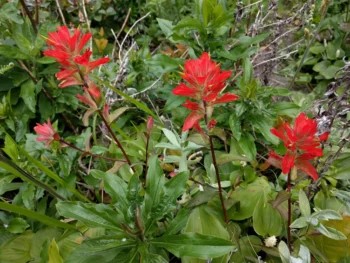
Giant Red Indian Paintbrush: A Rare Pacific Northwest Native Worth Knowing
If you’ve ever hiked through the stunning landscapes of the Pacific Northwest and spotted brilliant red-orange blooms painting the meadows, you might have encountered the giant red Indian paintbrush (Castilleja miniata dixonii). This perennial wildflower is a true gem of North American native flora, though it’s one that comes with both beauty and challenges for the home gardener.
What Makes Giant Red Indian Paintbrush Special
The giant red Indian paintbrush is a fascinating forb herb – essentially a non-woody flowering plant that returns year after year. What catches your eye aren’t actually the flowers themselves, but the vibrant red-orange bracts (modified leaves) that surround the small, inconspicuous flowers. These colorful displays create those spectacular painted meadows that make hikers stop in their tracks.
This plant is also known by its scientific synonyms Castilleja dixonii and Castilleja miniata var. dixonii, reflecting some taxonomic shuffling over the years – botanists love to keep us on our toes!
Where You’ll Find This Native Beauty
Giant red Indian paintbrush is native to a relatively small region of North America, calling home to parts of Alaska, British Columbia, Oregon, and Washington. This makes it a true Pacific Northwest specialty, adapted to the unique conditions of this corner of the continent.
- Species observed
- No observations
A Word of Caution: Rarity Matters
Before you start planning your paintbrush garden, there’s something important to know: this plant has a conservation status that suggests it may be uncommon to rare in parts of its range. If you’re lucky enough to encounter it in the wild, please admire it from a distance and never collect seeds or plants from natural populations.
Should you wish to grow this species, only purchase from reputable native plant nurseries that can guarantee responsibly sourced, ethically propagated material.
The Challenge of Growing Indian Paintbrush
Here’s where things get interesting (and a bit tricky). Indian paintbrush species, including our giant red variety, are what botanists call hemiparasites. This means they’re partially parasitic, attaching their roots to nearby host plants to borrow some nutrients and water. It’s not as sinister as it sounds – they still photosynthesize and make their own food, they just like a little extra help from their neighbors.
This parasitic nature makes Indian paintbrush notoriously difficult to grow in typical garden settings. They need the right host plants nearby to thrive, and recreating these complex relationships in a home garden is challenging even for experienced native plant gardeners.
Growing Conditions and Care
If you’re determined to try growing giant red Indian paintbrush, here’s what you should know:
- Prefers well-draining soils – soggy conditions are a no-go
- Needs full sun to partial shade
- Requires host plants nearby (grasses and other wildflowers work well)
- Thrives in USDA hardiness zones approximately 3-8, based on its native range
- Once established, it’s quite drought-tolerant
The reality is that this plant is best appreciated in its natural habitat or in specialized native plant gardens managed by experienced horticulturists.
Wildlife and Pollinator Benefits
When giant red Indian paintbrush does bloom, it’s a pollinator magnet. Hummingbirds are particularly fond of the tubular flowers, and various butterflies and native bees also visit. In its natural ecosystem, it plays an important role in supporting the web of life that makes Pacific Northwest meadows so vibrant.
Better Alternatives for Your Garden
If you’re inspired by the beauty of giant red Indian paintbrush but want something more garden-friendly, consider these easier-to-grow Pacific Northwest natives:
- Monarda (bee balm) for similar red blooms that attract hummingbirds
- Aquilegia formosa (western columbine) for red flowers with different form
- Penstemon species for tubular flowers in various colors
- Geum triflorum (prairie smoke) for interesting seed heads and spring color
The Bottom Line
Giant red Indian paintbrush is absolutely worth knowing and appreciating, but it’s probably not the best choice for most home gardens. Its rarity status means we should be extra thoughtful about conservation, and its parasitic nature makes cultivation genuinely challenging.
Instead, consider this beautiful wildflower as motivation to explore Pacific Northwest natural areas where you can observe it thriving in its preferred habitat. Sometimes the best way to garden with native plants is to support the wild spaces where they naturally occur – and giant red Indian paintbrush is a perfect reminder of that principle.