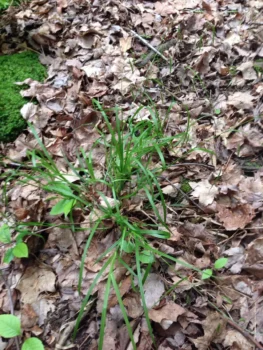
Graceful Sedge: A Native Beauty for Shady Spots
If you’re looking for a native plant that adds subtle elegance to your shade garden without being a diva, meet graceful sedge (Carex gracillima). This unassuming perennial sedge might not win any flashy flower contests, but it’s the kind of reliable, graceful plant that makes garden designers swoon.
What Makes Graceful Sedge Special?
Graceful sedge is a true North American native, naturally occurring across a impressive range from Canada down through the eastern United States. You’ll find this adaptable sedge growing wild in states from Maine to Georgia, and from the Atlantic coast all the way west to Minnesota and Arkansas. It’s also native to several Canadian provinces, making it a truly continental species.
- Species observed
- No observations
This perennial sedge forms attractive clumps that reach about 3 feet tall at maturity, with narrow, dark green leaves that arch gracefully (hence the name!). The growth habit is what botanists call bunch-forming, meaning it grows in neat, well-behaved clumps rather than spreading aggressively throughout your garden.
Why You Might Want Graceful Sedge in Your Garden
Here’s where graceful sedge really shines: it’s a shade-tolerant workhorse that thrives where many other plants struggle. If you have those tricky spots under trees or on the north side of your house, this sedge could be your new best friend.
The plant offers several garden benefits:
- Excellent for naturalizing woodland areas
- Provides fine-textured contrast in shade gardens
- Helps with erosion control on slopes
- Requires minimal maintenance once established
- Long-lived perennial that gets better with age
While graceful sedge won’t attract butterflies with showy blooms (it produces small, inconspicuous green flowers in late spring), it does provide valuable habitat structure for small wildlife and birds.
A Note About Rarity
Before you rush out to find graceful sedge, there’s something important to know: this species is considered rare in Arkansas, where it has an S1 rarity status. If you’re gardening in Arkansas or purchasing plants, make sure you’re buying from reputable nurseries that source their plants responsibly rather than collecting from wild populations.
Growing Conditions and Care
One of the best things about graceful sedge is how adaptable it is to different growing conditions, though it does have some preferences:
Soil: Prefers medium to fine-textured soils with good drainage, but can handle some moisture variation. It’s happy in slightly acidic soils (pH 4.7-6.9) and has medium fertility requirements.
Light: This is where graceful sedge really excels – it’s shade tolerant, making it perfect for woodland gardens and other low-light areas.
Water: Has medium moisture requirements and low drought tolerance, so it appreciates consistent moisture but doesn’t want to be waterlogged.
Hardiness: Extremely cold hardy (down to -33°F), suitable for USDA zones 3-8.
Planting and Maintenance Tips
Getting graceful sedge established in your garden is refreshingly straightforward:
- Plant in spring for best establishment
- Space plants about 12-18 inches apart (you can fit 2,700-4,800 plants per acre if you’re doing large-scale plantings)
- Water regularly the first year while roots establish
- Mulch around plants to retain moisture and suppress weeds
- Cut back old foliage in late winter or early spring
- Divide clumps every 3-4 years if desired, though it’s not necessary
The plant has a slow growth rate, so be patient – good things come to those who wait! Once established, it’s remarkably low-maintenance.
Where Graceful Sedge Fits in Your Landscape
Think of graceful sedge as the reliable supporting actor in your garden drama. It’s perfect for:
- Woodland and shade gardens
- Native plant gardens
- Rain gardens (it has medium wetland tolerance)
- Naturalizing large areas
- Erosion control on shaded slopes
- Providing texture contrast with broader-leaved plants
The semi-erect, fountain-like growth habit makes it an excellent companion for ferns, wild gingers, and other shade-loving natives.
The Bottom Line
Graceful sedge might not be the flashiest plant in the nursery, but it’s exactly the kind of dependable, native beauty that forms the backbone of sustainable gardens. If you have shady spots that need something elegant and low-maintenance, and you can source plants responsibly, graceful sedge deserves a spot on your wishlist. Just remember to be patient with its slow growth – the best garden relationships are built to last!