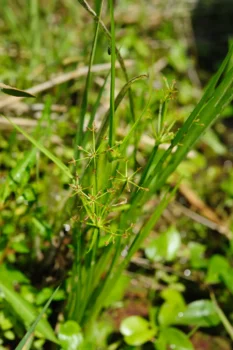
Haspan Flatsedge: A Water-Loving Sedge for Wet Gardens
If you’ve been searching for a plant that absolutely loves wet feet, let me introduce you to haspan flatsedge (Cyperus haspan). This unassuming sedge might not win any beauty contests, but it’s a champion when it comes to thriving in soggy conditions where other plants would simply give up and rot.
What Exactly Is Haspan Flatsedge?
Haspan flatsedge is a perennial sedge that belongs to the grass-like family of plants. Don’t let the grass-like description fool you into thinking it’s lawn material – this plant has very specific preferences and a particular personality. It grows in distinctive bunches, reaching up to about 3 feet tall, with narrow green foliage and small, inconspicuous brown flowers that appear in late spring.
The plant has a few botanical aliases, including Cyperus halpan (an alternate spelling) and Cyperus haspan var. americanus, but they’re all referring to the same water-loving character.
Where Does It Call Home?
Here’s where things get interesting – haspan flatsedge has a complicated relationship with geography. It’s native to parts of the lower 48 states, Puerto Rico, and various Pacific Basin locations, but it’s also considered non-native in Hawaii, where it has naturalized. You can find it growing in Alabama, Arkansas, Florida, Georgia, Hawaii, Louisiana, Mississippi, North Carolina, South Carolina, Tennessee, Texas, Virginia, as well as in Guam, Palau, and Puerto Rico.
- Species observed
- No observations
In Arkansas, this plant is actually quite rare, with a rarity status of S2, so if you’re in that area, you’re looking at a somewhat uncommon species.
Is This Plant Right for Your Garden?
The big question every gardener asks: should I plant this in my yard? The answer depends entirely on what kind of garden situation you’re dealing with.
The Good News
- Excellent for wet, boggy areas where nothing else will grow
- Great for erosion control near water features
- Low maintenance once established
- Fire resistant
- Long lifespan
- Tolerates various soil types (coarse, medium, and fine textured)
The Reality Check
- Very low drought tolerance – this plant demands moisture
- Not particularly ornamental
- Limited wildlife value
- Intolerant of shade
- Slow to establish and spread
Growing Conditions and Care
If you’ve decided that haspan flatsedge might be your cup of tea, here’s what you need to know about keeping it happy:
The Must-Haves
- Water, water, everywhere: This plant has Obligate Wetland status in most regions, meaning it almost always occurs in wetlands. Think pond edges, rain gardens, or that perpetually soggy spot in your yard.
- Sunshine: Full sun is preferred, as it’s shade intolerant
- Warmth: Hardy in USDA zones 8-11 (needs minimum temperatures above 7°F)
- Growing season: Needs at least 230 frost-free days
Soil Preferences
Haspan flatsedge is surprisingly adaptable when it comes to soil, as long as it stays wet. It can handle pH ranges from 4.5 to 7.5 and has high salinity tolerance, making it useful near coastal areas. It also tolerates medium levels of anaerobic conditions – perfect for those waterlogged soils.
Planting and Propagation
The easiest way to establish haspan flatsedge is through sprigs rather than seeds. Plant sprigs at a density of 3,500 to 4,800 per acre if you’re doing large-scale restoration work. For home gardens, space individual clumps about 2-3 feet apart.
Seeds are produced from summer through fall and persist well, but the plant has a slow seed spread rate and medium seedling vigor, so sprig propagation is more reliable.
What Kind of Garden Is This For?
Haspan flatsedge isn’t for your typical perennial border or cottage garden. Instead, consider it for:
- Rain gardens and bioswales
- Pond and stream margins
- Wetland restoration projects
- Erosion control in wet areas
- Naturalized wet meadows
Wildlife and Ecological Value
While haspan flatsedge won’t attract clouds of butterflies or hummingbirds (it’s wind-pollinated with inconspicuous flowers), it does provide some ecological benefits. The seeds may be eaten by waterfowl and other wetland birds, and the plant structure can provide cover for small wetland creatures.
A Few Words of Caution
Given its mixed native status depending on your location, it’s worth checking whether haspan flatsedge is considered native in your specific area before planting. If you’re in a region where it’s non-native, you might want to consider native sedge alternatives that provide similar benefits.
Also, if you’re in Arkansas where it’s rare, make sure any plants you acquire are from responsibly sourced, propagated material rather than wild-collected specimens.
The Bottom Line
Haspan flatsedge is definitely a specialist plant – it does one thing very well, which is thriving in wet conditions. If you have a consistently moist to wet area in your landscape that needs vegetation, and you’re in zones 8-11, this sedge could be a practical solution. Just don’t expect it to be the star of your garden show; think of it more as the reliable supporting actor that keeps everything running smoothly behind the scenes.
For most gardeners, there are probably more ornamental and wildlife-friendly options available, but for wetland restoration, erosion control, or that impossible boggy spot where nothing else will grow, haspan flatsedge might just be your answer.