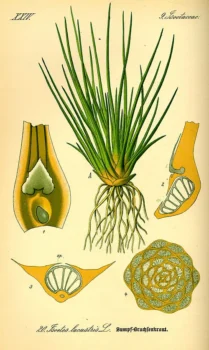
Lake Quillwort: A Rare Aquatic Treasure Worth Protecting
If you’ve ever wondered what plants looked like millions of years ago, meet the lake quillwort (Isoetes lacustris) – a living fossil that’s been quietly thriving in cold, clear lakes since before dinosaurs roamed the Earth. This isn’t your typical garden plant, and honestly, that’s probably for the best given its fascinating but finicky nature.
What Exactly Is Lake Quillwort?
Lake quillwort belongs to an ancient group of plants called quillworts, which are more closely related to ferns than to the grasses they resemble. These perennial aquatic plants produce clusters of narrow, grass-like leaves that emerge directly from the muddy bottom of lakes and ponds. Don’t expect showy flowers – like their fern cousins, quillworts reproduce through spores rather than seeds.
The plant gets its quill name from its distinctive needle-like leaves that can grow 4-8 inches tall, creating underwater meadows that look remarkably like a porcupine’s back sprouting from the lake floor.
Where Does Lake Quillwort Call Home?
This cold-water specialist is native to northern regions across North America, including Canada, Greenland, and the northern United States. You’ll find it naturally occurring from the Maritime provinces of Canada all the way west to Saskatchewan, and south through states like Maine, New Hampshire, Vermont, Minnesota, and Wisconsin, with isolated populations reaching as far south as Tennessee and Virginia.
- Species observed
- No observations
A Plant in Peril
Here’s where things get serious: lake quillwort is rare and getting rarer. It’s listed as endangered in New Jersey and faces threats throughout much of its range. This isn’t a plant you can simply order from a nursery catalog, nor should you attempt to harvest it from the wild.
The species requires very specific conditions – cold, clear, nutrient-poor lakes with stable water levels. Unfortunately, pollution, development, and climate change have made such pristine habitats increasingly scarce.
Should You Grow Lake Quillwort in Your Garden?
In a word: don’t. And here’s why:
- Rarity concerns: This plant is too rare and ecologically important to remove from wild populations
- Extremely specific needs: Requires cold, oligotrophic (nutrient-poor) water conditions that are nearly impossible to replicate
- Not ornamental: Even if you could grow it, the small, grass-like appearance offers little visual appeal
- Conservation priority: Every wild specimen is valuable for the species’ survival
How to Identify Lake Quillwort
If you’re lucky enough to spot this rare plant in its natural habitat, here’s what to look for:
- Narrow, grass-like leaves growing in clusters directly from the lake bottom
- Leaves are typically 2-8 inches long with a distinctive quill-like appearance
- Usually found in 1-10 feet of water in clear, cold lakes
- Often forms small colonies or scattered individuals
- Most visible during low water periods when tips may emerge above the surface
Supporting Lake Quillwort Conservation
Instead of trying to grow this rare beauty, consider supporting its conservation:
- Protect lake water quality in areas where it naturally occurs
- Support organizations working to preserve clean, cold-water lake ecosystems
- Report sightings to local botanists or natural heritage programs
- Choose native aquatic plants that are more common and suitable for cultivation
Better Alternatives for Your Water Garden
If you’re inspired by the idea of native aquatic plants, consider these more garden-friendly options that won’t impact rare populations:
- Wild rice (Zizania species) for larger ponds
- Native water lilies (Nymphaea species)
- Pickerel rush (Pontederia cordata)
- Native sedges for pond margins
Lake quillwort reminds us that not every native plant belongs in our gardens – sometimes the best way to appreciate and support a species is to protect its wild homes and admire it from a respectful distance. In a world where so many plants face extinction, every wild lake quillwort population is a treasure worth preserving for future generations to discover and wonder at, just as we do today.